Sketch Book Vampires


backlit dark dawn environment

Photo by Pixabay on Pexels.com

BY TRACY HOFFMAN

March 27, 2019

While contemplating a blog topic for today, the following post came across my email account: “JTO: Fall 19: The Black Vampyre; A Legend of St. Domingo.”

The message came through the L-C19-Americanists ListServ, signed by Duncan Faherty and Ed White. First off, if you’re not familiar with JTO, it means “Just Teach One.” The project encourages professors to teach an understudied, neglected text.

The request to teach The Black Vampyre asks instructors to teach the text this fall and then submit a blog post about the classroom experience.

What struck me in this call for a blog: Washington Irving and Lord Byron are mentioned. The Black Vampyre was published in 1819, the same year Irving began publishing The Sketch Book.

I have not read the book, and I’m not clear on the loop between Uriah Derick D’Arcy, who signed The Black Vampyre, Washington Irving, and Lord Byron. But it sounds like an intriguing connection.

I’ve been arguing for years that Irving’s comments about Native-Americans could easily be translated into similar sentiments for African-Americans, and I’m even more convinced of that as I have been studying “The Devil and Tom Walker.” A look at this neglected novel, which deals with race, might add much to the conversation I’ve pursued with Irving.

Katie Bray’s 2015 American Literature article deals with the issue, so I’ll be investigating Bray’s study and checking out the text in the weeks ahead, to see if I can make it work for the fall (American Literature, Volume 87, Number 1, March 2015 DOI 10.1215/00029831-2865163 © 2015 by Duke UP).

Until next week, please feel free to add to the conversation wherever you like: Twitter, Facebook, on this page. Comments are very much welcomed. Also feel free to message me at Tracy_Hoffman@baylor.edu. I try to respond to all correspondence on Wednesdays, and I also update the WIS page on Wednesdays.

Published in: on March 27, 2019 at 7:20 pm  Leave a Comment  

Invoking the “Spirit of Rip Van Winkle,” Awakening to Research Opportunities

adult book boring face

Photo by Pixabay on Pexels.com

BY TRACY HOFFMAN

March 20, 2019

Last week, my Spring Break, I thought about posting a Wednesday blog, but then the “spirit of Rip Van Winkle” came over me. I got a little lazy, wanting to relax more than write, so I rationalized how even Washington Irving would want a respite if he had been offered a Spring Break back in the 1800s.

At the very least, Washington Irving would have traveled over Spring Break, carrying a sketch pad to scribble ideas for future books, but I’m pretty sure he would have resisted blogging, too.

So I’m back to posting on Washington Irving Wednesdays, after taking off last week.

This morning, the character Rip Van Winkle and his sketch are still on my mind. I’m thinking about ways we could research children’s versions of the story, perhaps gathering useful data on “Rip Van Winkle.”

Over the years, I’ve thought about conducting a project where undergraduate students and I would read “Rip Van Winkle” to children in schools and libraries, to get feedback on the tale. But I’ve never jumped into this arena. Baylor even runs a childcare center, perhaps a good place to conduct such a study. But again, I’ve been lazy about getting into this business.

Several years ago, I maneuvered my way onto a Children’s Literature panel at a national conference to talk about “Rip Van Winkle.” Audience members tore apart my research! Basically, I was applying the wrong scholars. These experts were correct, since I’m an Early Americanist/Irving scholar, but I felt like I was being scolded in the principal’s office.

We scholars often do this sort of thing: dabble in areas outside our comfort zones. I’ve been involved in panels on Muslim Studies because of Irving’s writings on Islam. I’m not an Islamicist, but these experts always make me feel very welcomed. And I could go on and on, as most scholars could, about giving talks on areas outside our fields of study. They typically go very well.

I’m laughing out loud to myself thinking about this Children’s Literature episode, but I need to get over this odd, rare exception to friendly circles of scholars, and reconsider Children’s Literature as an avenue of study.

Yesterday, a former student awakened my thoughts on Rip Van Winkle. This student, who took one of my classes in the fall, sent me a questionnaire about undergraduate research grants. She needs answers for a project she’s working on for a professional writing class. Evidently, she wants professors to request more grant money for undergraduate research.

Typically, an undergrad will do research under my guidance if the student is working on an Honors College thesis, a smaller version of a master’s thesis. These students approach me because they’ve taken me for a class and our research interests intersect. But that’s about it.

I have memories of undergrad professors using we students to help them work on their books, and I don’t want to manipulate my students in that way. However, I should be more open to setting up win-win situations, where their research benefits them and compliments what I’m studying and/or teaching.

December 2017, I could have used some undergraduate research funds when a senior English major and I traveled to Yosemite National Park to attend the Bracebridge Dinner. She’s now headed to grad school pursuing Medieval Literature. Our interests collided because she wanted to witness a madrigal dinner, and I wanted to see the Irving-inspired extravaganza. In one of my junior-level classes, she had also worked on an extensive research project regarding Irving’s Christmas stories, inspired by medieval tradition.

Sadly, the deadlines for grant money didn’t align with our time frame. If I had applied for grant money when we realized we needed money, the student would have graduated by the time we received the grant. And that’s my general spin on grant money with undergrads. I’m not working with the same students every semester, so plotting research projects with them would require extraordinary measures. And like I said, I’m lazy too often to muster up such energy.

I’m wondering, though, if someone were teaching in a smaller high school or university setting where they see the same students often, if research projects could be managed efficiently, making grant money an easier grab. I’m thinking about a small school district near me where all students are housed in one building. Surely, a small school district like that would be excited about studying some “Rip Van Winkle” and getting funding to do so.

But I also wonder if small districts have greater needs than learning about Washington Irving; grant money might be needed for higher priority requests. If so, then bringing in a team from the university would be a better approach, if we can get funding from our end.

I haven’t forgotten about “The Devil and Tom Walker” and ways we might teach this story. Thoughts about “Rip Van Winkle” and research have me thinking about the Walkers, too. What data might be useful when studying the miserly couple?

Washington Irving studies, like most areas of literary research, needs digital archiving. Master’s students tend to take on these very important tasks. Nevertheless, I should be thinking about smaller digital projects for undergrads.

Thanks to my former student for reminding me of undergraduate research efforts. We will do better!

Until next week, please feel free to add to the conversation wherever you like: Twitter, Facebook, on this page. Comments are very much welcomed. Also feel free to message me at Tracy_Hoffman@baylor.edu. I try to respond to all correspondence on Wednesdays (unless it’s Spring Break!), and I also update the WIS page on Wednesd

Published in: on March 20, 2019 at 5:44 pm  Comments (1)  

Great Awakenings in Washington Irving’s “The Devil and Tom Walker”

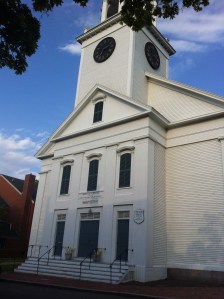
Meeting House of the First Presbyterian Society Erected 1756. Photo taken in Boston by Tracy Hoffman.

BY TRACY HOFFMAN

Wednesday, March 6, 2019

Several articles, podcasts, and online discussions as of late have me thinking about “The Devil and Tom Walker” in new ways.

Some very good people I know and know of seem to think academics are discrediting America and her past. I can only speak for myself, though my perspective is certainly shared by many, that what we’re working toward is a richer history: more facts, not less, certainly not deleting information.

New Historicism1, of course, is no longer new, and we continue to grapple with what history and the facts mean. That’s true for Americanists and most Americans, for that matter, who try to keep up with what’s going on in the world in light of the past.

What some label negatively as “rewriting history” is really an attempt to present more context, more texts, more data to involve groups underrepresented in our traditional history telling. I’m trying to look at this Irving text not only as opportunity to talk about America’s traditional representations of history and literature but also to think about untold stories.

What overlooked historical context can we provide for this story? What other texts might be paired with “Tom Walker”?

Irving comments upon the Great Awakening when he sets up the sketch “About the year 1727, just at the time when earthquakes were prevalent in New England, and shook many tall sinners down upon their knees, there lived near this place a meagre miserly fellow of the name of Tom Walker.”

By simply googling the year 1727, some interesting items jump out to me. For one, Irving is alluding to both the literal earthquake striking New England while also joking about spiritual revival. During this same year, the “NY General assembly permits Jews to omit phrase ‘upon the faith of a Christian’ from abjuration oath” (https://www.onthisday.com/events/date/1727). This makes me wonder if people of other faiths were allowed the same courtesy.

Do we ever talk about Jews, Muslims, or even Catholics when we talk about the Protestant revivals in America? I’m reminded of Benjamin Franklin’s autobiography where he talks about the importance of meeting houses, for anyone to use, even “a missionary to preach Mohammedanism to us” (https://www.gutenberg.org/files/20203/20203-h/20203-h.htm).

Irving also loosely references the Salem Witch Trials: “The good people of Boston shook their heads and shrugged their shoulders, but had been so much accustomed to witches and goblins and tricks of the devil in all kinds of shapes from the first settlement of the colony, that they were not so much horror struck as might have been expected.”

According to “good ‘ole Wikipedia,” the year 1727 is important to the study of witch trials: “An old woman known as Janet (Jenny) Home of Loth Sutherland becomes the last alleged witch in the British Isles to be executed when she is burned at the stake in Dornoch, Scotland” https://en.wikipedia.org/wiki/1727.

To me, these two are obvious: the Great Awakening and the Salem Witch Trials. But what might I be missing? If I could look through different lenses, theoretical approaches if you will, what might I notice? What psychology is at play in the story? What’s the socioeconomic situation of the setting? What cultures and races deserve attention? What might the story say about gender?

We know Harvard University was around in Boston during this time, as it was founded in the 1600s. Students would be aware of Harvard’s current reputation. Talking about the role of the university as a seminary for white male students might be of interest to them. I’m reminded of Phillis Wheatley’s poem addressed to the students of Cambridge, what Harvard used to be called.

Of course, we also have many of the events leading up to the American Revolution taking place in Boston: the Boston Tea Party, the Boston Massacre, etc. Those trying to teach “The Devil and Tom Walker” in a high school setting might present the story alongside key events that took place later in Boston.

I recently listened to the Ben Franklin’s World podcast about the Boston Massacre. Learning that the Boston area was in decline, leading up to the American Revolution, was intriguing to me. Places like Philadelphia and New York were booming in comparison. Socioeconomic considerations should be obvious paths to investigate since the story deals with the miserly Mr. and Mrs. Tom Walker.

I’ll be keeping my eye out for new ways to teach the story, particularly with regard to financial concerns in Boston and Salem during the 1720s. I’m also thinking about context and complimentary texts for each story in The Sketch Book, since we’re celebrating its 200th anniversary. I’m hoping to use the book as an anchor for one of my American Lit classes in the fall, but I really need to think through what texts would work well with it.

Until next week, please feel free to add to the conversation wherever you like: Twitter, Facebook, or on this page. Comments are very much welcomed. Also feel free to message me at Tracy_Hoffman@baylor.edu. I try to respond to all correspondence on Wednesdays, and I also update the WIS page.

  1. For a definition of New Historicism, see: http://www.newworldencyclopedia.org/entry/New_Historicism
Published in: on March 7, 2019 at 1:56 am  Leave a Comment  

The Father of American Literature: Irving’s Legacy on Display in “The Devil and Tom Walker”

teal fujifilm instax mini camera near white ceramic mug

Tom Walker and his wife lose their souls in their travels about Boston in “The Devil and Tom Walker” from Tales of a Traveller. Photo by Element5 Digital on Pexels.com


BY TRACY HOFFMAN

Wednesday, February 27, 2019

Washington Irving is considered the Father of American Literature for many reasons. He proved America had a decent writer, “a man of letters,” who produced a large body of beautifully-written work. His books influenced so many great writers to come, and much like Benjamin Franklin who thrived in the printing business, Irving was able to support himself solely by writing.

What occurred to me last night was how much “The Devil and Tom Walker” demonstrates Irving’s legacy: his influence on so many other writers, on both sides of the Atlantic.

Last night, a little before 11 p.m., I re-read “The Devil and Tom Walker” a few times. In all honesty, I was looking for any hint of Mary Shelley, since scholars were chatting about his connection with her yesterday on Twitter, and since I know Irving was working on this story when he was moving in Mary Shelley circles.

However, what struck me last night and has stayed with me this morning, instead, is a laundry list of texts which could easily be paired with this short story because you see Washington Irving’s influence in them.

Irving Independent School District, in Irving, Texas, has added “The Devil and Tom Walker” to its reading list, so I’ve been blogging about this sketch which appears in Tales of a Traveller. Perhaps some of my musings of other texts I teach or might want to teach will be useful to other instructors also looking for connections with other texts.

First off, Ebenezer Scrooge from A Christmas Carol by Charles Dickens reminds me of Tom Walker in the latter part of the story when Old Scratch carries him away on the dark horse. I already teach Irving’s Christmas stories and explain how the holiday sketches influenced Dickens, but I hadn’t thought about “Tom Walker” as it relates to Ebenezer. Dickens reforms Scrooge, but Irving gives Walker a sad ending. Though Walker attempts church-going to negate his “deal with the Devil,” in the end, he loses his soul.

And how can we not see Nathaniel Hawthorne’s “Young Goodman Brown” in “The Devil and Tom Walker”? The setting of time and place are the same, and like Brown, Walker carries a staff when he wanders into the forest.

Of course, Mary Rowlandson’s narrative, set in Massachusetts, might also pair well. Irving’s tone about hypocrisy should readily resonate with readers of Hawthorne, as we also consider Rowlandson’s attitude toward natives. And Zitkala Ša’s Impressions from an Indian Childhood, I think, also works with Rowlandson.

When Irving describes the Devil’s color as sooty, rather than designating a particular race, I’m reminded of Toni Morrison’s “Recitatif” and her presentation of stereotypes, too.

“The Devil and Tom Walker” contains three levels of narration. Washington Irving wrote the book under the pen name of Geoffrey Crayon, a fictitious American narrator who has traveled in Europe. Finally, another fictitious narrator, a Cape Cod whaler, relays the story of “The Devil and Tom Walker.” Therefore, it seems to me, that Herman Melville’s Moby Dick might be a comparable text, especially if you discuss the role of narrator. Students could readily see a sailor’s perspective, especially at the beginning of Walker’s story about inlets, pirates, treasure, and maneuvering the waters near Boston.

The discussions of “the Indian fort” reminds me of James Fenimore Cooper’s Last of the Mohicans. And any chat about Irving and Cooper is fun for me and my classes. Irving spoke at Cooper’s funeral, and I can imagine Cooper, who was critical of Irving’s writing, rolling over in his grave. The irony of Cooper suggesting Irving was too soft on social ills stands out to me in the Walker story. And I will definitely blog another time to talk about Irving’s jabs at usury, slavery, and the mistreatment of Native-Americans, all evident in “The Devil and Tom Walker.”

Until next week, please feel free to add to the conversation wherever you like: Twitter, Facebook, on this page. Comments are very much welcomed. Also feel free to message me at Tracy_Hoffman@baylor.edu. I try to respond to all correspondence on Wednesdays, and I also update the WIS page.

Published in: on February 27, 2019 at 6:38 pm  Leave a Comment  

Author Societies: Watchdog Groups?

american pit bull terrier

Photo by Viktoria B. on Pexels.com

BY TRACY HOFFMAN

Wednesday, February 20, 2019

If journalists have been traditionally viewed as “the watchdog of government,” should an author society consider itself the protector of truth about its writer? Should society members be the barking dogs to point out “untruths” we see being spread on social media?

As often is the case, yesterday, Washington Irving made the “quote of the day” on various feeds, which is a good thing. It’s nice to see the world abuzz about “an old, dead white guy” I study. But tweeters failed to give the textual source for the quote.

I was reminded of my “lecture series” which students get on rudeness in writing. Whenever I talk about plagiarism with entry-level writing classes, I often make a forceful comment, which goes something like this: “It may not be plagiarism, but it might be rude.”

For instance, mechanical engineers may consider something common knowledge in their sphere, but if they’re trying to write a document for a general audience, not providing additional information and/or some citation could be very rude.

I remind students to be kind to their readers. Let them know where they can go for further information. If you didn’t “borrow” the information, then it’s not plagiarism, but please tell readers where they can go to find out more.

If I can’t easily figure out the source of a quote, it drives me batty! And if I don’t readily recognize an Irving quote, then certainly a general audience, the recipient for such “quotes of the day,” would have no idea.

Here’s the quote which ran all over the place yesterday, Tuesday, February 19, 2019:

“Little minds are tamed and subdued by misfortune, but great minds rise above it.”

As you might imagine, all kinds of self-help, business-minded folks used the quote as motivational material, and I suppose that’s why the quote made the cut.

After some digging around, I found the source of the quote: “Philip of Pokanoket” from The Sketch Book. The passage sets up the death of the Wampanoag chief. Though Irving paints the Native-American leader as “a patriot attached to his native soil—a prince true to his subjects and indignant of their wrongs,” in the “quote of the day,” Philip arouses his “great mind” to kill.

Here are the lines which follow “the quote of the day”:

“The very idea of submission awakened the fury of Philip, and he smote to death one of his followers who proposed an expedient of peace. The brother of the victim made his escape, and in revenge betrayed the retreat of his chieftain. A body of white men and Indians were immediately despatched to the swamp where Philip lay crouched, glaring with fury and despair. Before he was aware of their approach, they had begun to surround him. In a little while he saw five of his trustiest followers laid dead at his feet; all resistance was vain; he rushed forth from his covert and made a headlong attempt to escape, but was shot through the heart by a renegade Indian of his own nation.”

Typically, I try not to correct people on Twitter, Facebook, or anywhere else. People generally don’t want to be corrected. The context for this quote, though, seemed worthwhile enough to share. I also thought it might introduce some people to Irving’s concerns about Native-Americans in the early republic.

I posted the following:

“ ‘Little minds are tamed and subdued by misfortune, but great minds rise above it’ deals with Native-American conflict and comes from Irving’s ‘Philip of Pokanoket.’ Context is important. Full text at www.gutenberg.org.”

In scholarly publications, we attempt to straighten out the facts, context, and more about texts and writers, but should we feel at all obligated to correct misinformation spread about our writers in social media?

People will probably always use “Romeo and Juliet” references to describe couples in love, even though the pair committed suicide. Edgar Allan Poe fans will probably continue to circulate all sorts of nonsense about his death, though no autopsy was performed.

Instead of being bothered by lack of context or “fake news,” should I instead be content knowing countless people are still quoting from The Sketch Book in 2019—200 years after it was published?

Until next week, please feel free to add to the conversation wherever you like: Twitter, Facebook, on this page. Comments are very much welcomed. Also feel free to message me at Tracy_Hoffman@baylor.edu. I try to respond to all correspondence on Wednesdays, and also update the WIS page.

By the way, I haven’t forgotten about Tales of a Traveller. I’ll get back to it, but wanted to address this issue while it’s still fresh on my mind.


Published in: on February 21, 2019 at 2:17 am  Leave a Comment  

Valentine’s Week Musings: Broken-Hearted Washington Irving

February 2019 Heritage Tea

The City of Irving’s Heritage Society 2019 Valentine Tea. Photo by Tracy Hoffman


BY TRACY HOFFMAN

Wednesday, February 13, 2019

On this Valentine’s Eve, I’m thinking about Irving’s young, innocent female characters and also his heart-broken widows in The Sketch Book and Tales of a Traveller. These female characters contrast greatly with nagging Dame Van Winkle and miserly Mrs. Tom Walker.

Stories of innocent love, in particular, are fresh on my mind because my American Lit classes are reading some of these sappy stories this week. On Monday, I also briefly lectured about Irving’s love interests: Matilda Hoffman, Emily Foster, Mary Shelley.

Though I sometimes teach A Tour on the Prairies and the full Sketch Book, I typically spend three classes on a handful of Irving sketches: one day on “Rip Van Winkle” and “The Legend of Sleepy Hollow,” one day on the Christmas stories, and the last day, I experiment with other sketches. Because I also teach Mary Rowlandson’s captivity narrative, Irving’s romantic depictions of Native Americans, namely “Philip of Pokanoket” and “Traits of Indian Character” from The Sketch Book, offset Rowlandson’s depictions of Amerindians.

Since our Irving readings this semester fall on Valentine’s week, I opted to assign “The Wife,” “The Broken Heart” and “The Specter Bridegroom” in place of “Philip of Pokanoket” and “Traits of Indian Character.”

Believe it or not, many of the men in my class told me “The Wife” and “The Broken Heart” were their favorite reads thus far this semester.  Students also distinguished Leslie’s wife and the remarried widow from “The Broken Heart” with our previously discussed coquette Katrina Van Tassel and nag Dame Van Winkle.

Ironically, this morning, as I scrolled the Irving Society Twitter feed in honor of “Washington Irving Wednesday,” I was reminded of Irving’s most quoted passages, many of which come from these sentimental tales. We scholars sometimes forget: what we consider kitschy is often loved by the masses. Sadly, most Twitter posts don’t cite the texts, so I’ll throw out a few with the sources.

From “The Wife,” we get: “There is in every true woman’s heart a spark of heavenly fire, which lies dormant in the broad daylight of prosperity, but which kindles up, and beams and blazes in the dark hour of adversity.”

In “The Widow and Her Son,” Irving writes: “Oh! There is an enduring tenderness in the love of a mother to her son that transcends all other affections of the heart. It is neither to be chilled by selfishness, nor daunted by danger, nor weakened by worthlessness, nor stifled by ingratitude. She will sacrifice every comfort to his convenience, she will surrender every pleasure to his enjoyment, she will glory in his fame and exult in his prosperity; and, if misfortune overtake him, he will be the dearer to her from misfortune; and if disgrace settle upon his name, she will still love and cherish him in spite of his disgrace; and if all the world beside cast him off, she will be all the world to him.”

Because I’ve been blogging about “The Devil and Tom Walker,” which comes from Tales of a Traveller, I’ve also been thinking about the innocent young woman, wearing white, who is raped in the section about the Italian banditti. We sometimes say killing off Dame Van Winkle is like killing off the mother land of England. I can’t help but think Irving might be killing off the innocent female, much like his beloved Matilda Hoffman, as a way of killing off his past, of healing his broken heart.

At the time of its publication, reviewers thought Tales of a Traveller obscene because of this rape episode, among other troubling stories, but maybe Irving needed to write such a scene, whether conscious of it or not. Something to consider…

Until next week, please feel free to add to the conversation wherever you like: Twitter, Facebook, on this page. Comments are very much welcomed. Also feel free to message me at Tracy_Hoffman@baylor.edu. I try to respond to all correspondence on Wednesdays, and also update the WIS page.

By the way, this past Sunday, February 10, the Irving Heritage Society of Irving, Texas, hosted yet another wonderful Valentine’s Tea. If you’re ever in the Dallas-Fort Worth area on Valentine’s Sunday, be sure to drop by, as the tea is an annual event. Here’s a link:

http://www.irvingheritage.com/Archives/2019/valentine.tea_2.10.19%20_ihs_archives.html

Published in: on February 14, 2019 at 12:41 am  Comments (1)  

“The Devil and Tom Walker” in Paris

BY TRACY HOFFMAN

Wednesday, February 6, 2019

Last time, I left the blog pondering why Irving purchased celery and cabbage seeds while working on The Sketch Book. I haven’t solved the mystery yet, but I have checked out more journal entries, specifically ones he completed while writing “The Devil and Tom Walker.”

On Thursday, May 6, 1824, while in Paris, Irving records the following in his journal: “This morning wrote story of the Devil & Tom Walker.” On Friday, May 7, he writes: “Wrote all the morning at Tom Walker.” And on Saturday, May 8, he notes: “Wrote this morng at Story of Tom Walker” (Reichart, Journals and Notebooks III, 327-28).

His notations about writing the story continue on Monday, May 10: “Awoke early — Birds Singing — beautiful weather. breakfasted in my room Between 7 & 8. Wrote a little at the Story of Tom Walker, introducing dialogue between him & D[evil] – on subject of the bargain…” (Reichart 329).

Then later on Friday, May 21, Irving says, “This morning rewrote parts of Tom Walker & latter part of Wolfert Webber” (334).

He includes other tidbits in his 1824 journal entries from France, and I’ll point out a few highlights.

Though he mentions some purchases, he doesn’t seem overly concerned about financial matters even though he’s writing fiction with financial themes.

On Saturday, May 1, he writes: “A rainy day – Arranged & burnt papers, letters &c” (Reichart 326). How nice of him to burn letters and papers, which twenty-first century scholars might have found useful. (I’m sure many of them had to do with his tawdry love affair with Mary Shelley!)

Irving leaves Paris on Monday, May 24, for England. It is clear, then, that he writes “The Devil and Tom Walker” while in France.

On Tuesday, May 25, Irving jots down: “Anniversary of my departure from America” (335). He sets “The Devil and Tom Walker” in America though other stories in the collection are set in England, Italy, and even Paris.

Irving’s decision to stay abroad until he could prove himself financially as a writer combined with thoughts of America while in France confirm that the short story has some connections to Irving’s biography.

Until next week, please feel free to add to the conversation wherever you like: Twitter, Facebook, on this page. Comments are very much welcomed. Also feel free to message me at Tracy_Hoffman@baylor.edu. I try to respond to all correspondence on Wednesdays and also update the WIS page.

Published in: on February 7, 2019 at 5:25 am  Leave a Comment  

Cabbages and Cash: Irving’s Accounts Surrounding “The Devil and Tom Walker”

BY TRACY HOFFMAN

Wednesday, January 30, 2019

This Friday, February 1, I’m taking a class called “Accounting and Decision Making for Nonprofits” to help me with Washington Irving Society efforts.

Yesterday, I also had a lively conversation with some accounting majors about entry-level accounting, my toughest class in undergrad. I kept dropping the class every semester until senior year when I figured out I could take the class at a community college and transfer in the credit. Desperate times call for desperate measures!

This week, I’ve also been diving into the Twayne publication of Irving’s Journals and Notebooks Volume II, 1807-1822, which would be the time leading up to Tales of a Traveller. I was looking for something unrelated to “The Devil and Tom Walker,” but noticed some of Irving’s financial commentary.

This rabbit trail was bound to happen.

We know that Irving’s family hardware business in New York City and Liverpool went bankrupt prior to “The Devil and Tom Walker.” We also know Irving was out to prove himself financially as a writer and managed to achieve his goal. I’m wondering, though, how some curious financial details noted in his journals might enlarge our understanding of Irving and this story.

When Irving visits Stratford, England, the home of William Shakespeare, he records spending money on a coach, a play, a housekeeper, a butler, and the Shakespeare house (Reichart 59-60).

While in England in 1817, Irving jots down expenses for steam boat fares, breakfast, the mending of coats, gloves, celery and cabbage seed (166-67). Celery and cabbage seed! Why would Irving, a man of letters, need celery and cabbage seed while traveling through Europe?

We see cabbages pop up in his writing, most notably in “Wolfert Webber, or Golden Dreams,” the story following “The Devil and Tom Walker.”

In fact, Irving seems to make a huge deal about cabbages, kind of how my mother does on New Year’s Day. She says you need some black-eyed peas for good luck and some cabbage for cash. Is Irving making a similar statement here? Cabbage is code for cash.

Irving writes: “”The field in which Cobus Webber first planted himself and his cabbages had remained ever since in the family, who continued in the same line of husbandry, with that praiseworthy perseverance for which our Dutch burghers are noted. The whole family genius, during several generations, was devoted to the study and development of this one noble vegetable; and to this concentration of intellect may doubtless be ascribed the prodigious size and renown to which the Webber cabbages attained.”

In 1817, Irving  also jotted down some financial records while working on The Sketch Book. He keeps track of how many pounds he has in his possession, jotting down, “Half of money remaining in purse” (192).

Irving makes some miscellaneous entries, and the editors suggest these could be purchases he’s considering: “hat, trunk, watch, shoes” (284).

As noted previously, the study of debits and credits doesn’t fall under my areas of high expertise. Many Irving scholars write about economic considerations. I’ll be looking more into this cabbage business between now and next Wednesday, and I’ll let you know what the financial experts have to say.

Until next week, please feel free to add to the conversation wherever you like: Twitter, Facebook, on this page. Comments are very much welcomed. Also feel free to message me at Tracy_Hoffman@baylor.edu. I try to respond to all correspondence on Wednesdays and also update the WIS page.


Published in: on January 30, 2019 at 8:09 pm  Leave a Comment  

It’s Washington Irving Wednesday! Continuing with “The Devil and Tom Walker”


BY TRACY HOFFMAN

Wednesday, January 23, 2019

Last Wednesday, I discussed biographical context which might be of interest when teaching “The Devil and Tom Walker.” Today, I want to look at Diedrich Knickerbocker, the fictitious narrator of the story, and where the story falls contextually in the book, Tales of a Traveller (1824).

“The Devil and Tom Walker” appears in “Part IV: The Money Diggers,” the final section of Tales of a Traveller, and Irving credits this section to the late Diedrich Knickerbocker, the Dutch narrator from A History of New York (1809), as well as the narrator of “Rip Van Winkle” and “The Legend of Sleepy Hollow” in The Sketch Book (1819-1820).

Talking about Diedrich Knickerbocker’s connection to the New York Knicks might grab students’ attention. The term knickerbocker as a synonym for New Yorker started with Washington Irving’s narrator. Going over the entry from the Oxford English Dictionary with students might be worthwhile. They would quickly see the Irving connection as he’s credited for its first use. I’ve done this with my classes on occasion, especially if they will be doing research later in the semester. It lets them see how a definition can be useful in a literary analysis and why a quick Webster’s definition pales in comparison.

Diedrich Knickerbocker repeats the story “A Devil and Tom Walker,” but the story is technically told by “an iron faced Cape Cod whaler” when he and his buddies are out fishing on a boat with Diedrich. At the end of the sketch “Kidd the Pirate,” the whaler sets up the story thus: “By the way, I recollect a story about a fellow who once dug up Kidd’s buried money, which was written by a neighbour of mine, and which I learnt by heart. As the fish don’t bite just now, I’ll tell it to you, by way of passing away the time.”

We have a fishing story, told by a whaler, written by his neighbor, repeated by the late Diedrich Knickerbocker. As with many Irving stories, he gives us layers of narrators. Teaching students about framed narratives would certainly lend itself to “The Devil and Tom Walker.” Like digging for pirates’ treasure, we have to dig deep to figure out where the story originates, and even then, the truth is still fuzzy since each narrator adapts the story to his liking.

At the sketch’s conclusion, Knickerbocker explains his storytelling technique: “Such, as nearly I can recollect, was the purport of the tale told by the Cape Cod whaler. There were divers trivial particulars which I have omitted, and which whiled away the morning very pleasantly, until the time of tide favourable for fishing being passed, it was proposed to land, and refresh ourselves under the trees, until the noontide heat should have abated.”

To sum up, it looks like we have some enticing details for sports fans who may be sitting in our classrooms: fishing and the New York Nicks. And then we have pirate stories.

Next Wednesday, I’d like to talk about the story which follows this sketch. While the fishermen are at rest, Knickerbocker reminisces about his childhood haunts, and the group continues to swap stories. The one following “The Devil and Tom Walker” is called “Wolfert Webber, or Golden Dreams,” and this sketch is told by John Josse Vandermoere. The section is called “The Money Diggers,” so dealing with greed and the love of money as one’s downfall is a major thread in the Tom Walker story and also in “Golden Dreams.”

Until next week, please feel free to add to the conversation. Comments are welcomed. Also feel free to message me at Tracy_Hoffman@baylor.edu. I respond to WIS correspondence on Wednesdays and also update the WIS page then

.

Published in: on January 23, 2019 at 6:54 pm  Leave a Comment  

Welcome to Washington Irving Wednesdays!

BY TRACY HOFFMAN

Wednesday, January 16, 2019

I’m back to blogging on the Washington Irving Society page. As you might have noticed, I was very active in September, writing often, but then” fell off the face of the earth.” Sometimes, that’s how it goes during a semester. We start strong, but then other priorities in academia take over our lives.

Feedback about the blog and other improvements we’ve made to the WIS page has been very positive, so we will keep up the good work. But rather than attempting to post every day, the goal is to blog and update the website on Wednesdays: Washington Irving Wednesdays! If you want to stay updated on what’s happening, then you might consider having a Check the Washington Irving Page Thursday! (since it might be 11:59 p,m. on Wednesday, on occasion, to put things in order).

Here’s what I’m considering for the next handful of blogs. Irving Independent School District in the Dallas-Fort Worth Metroplex has included “The Devil and Tom Walker” in its curriculum. The story has been highly anthologized, so the plan is to think about and blog about this story to develop ideas and resources which might be useful to teachers there and elsewhere.

Though my undergraduate classes have read portions of the story as a teaser into Irving’s writing, I have not spent quality time with “The Devil” in the classroom. I tend to use the Norton Anthology, and it doesn’t include the story.

Unless it were a graduate seminar or a one-author class, I can’t imagine teaching all of the stories from Tales of a Traveller, the collection from which “The Devil and Tom Walker” appears. Providing background information about the collection, however, might be of interest to students.

The book was the third in what I would call Irving’s sketchbook trilogy, with The Sketch Book and Bracerbridge Hall as the first two installments. Both books were well-received, but Tales of a Traveller was not. Critics claimed the book was obscene, and even by twenty-first century standards, portions of the book are disturbing. How much an instructor would want to delve into the obscenities would, of course, depend on age bracket, school culture, your personal comfort level, etc.

Because the book didn’t go well, Irving left England to spend quality time in Spain: a decision which changed the trajectory of his writing. Talk about a really bad situation working into something really, really interesting! The book, therefore, marks a pivotal change in his writing career. Tales of the Alhambra, The Conquest of Granada, and Mahomet and His Successors came from his time in Spain, and we wouldn’t have the wonderful assortment had it not been for “The Devil and Tom Walker” and Tales of a Traveller.

Another “fun fact” about the short story collection has to do with Mary Shelley. Irving remained single his entire life, and Mary Shelley remained single after the death of her husband Percy. While Irving was working on Tales of a Traveller, we know that Mary Shelley had a crush on Washington Irving. They spent time together at the theater, Mary threw tea parties and invited Irving, and we have letters from Mary Shelley and others revealing her feelings for him.

During the time that these two were potentially “an item” Mary Shelley had published Frankenstein, and Washington Irving had published “The Legend of Sleepy Hollow” and “The Specter Bridegroom,” both from The Sketch Book. What a gothic connection! He was already experimenting with creepy topics before he entered Mary Shelley’s world, but I think their “dark encounter,” and other factors, took Irving’s writing to a more disturbing space.

I’ll cut the blogging off for now, but would like to come back next week to continue the conversation about reception history, context, and more–involving “The Devil and Tom Walker.”

Published in: on January 16, 2019 at 6:57 pm  Leave a Comment