Washington Irving Misses Opportunity to Travel with “Sinbads of the wilderness”

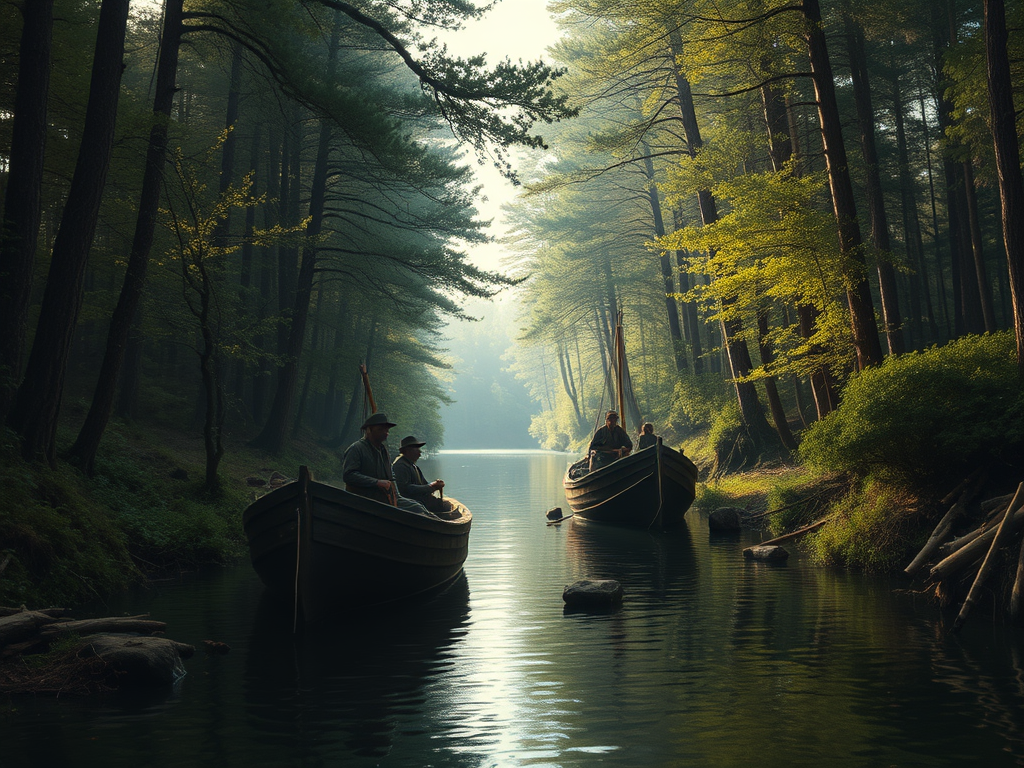
AI-generated image in WordPress

Wednesday, November 19, 2025

BY TRACY HOFFMAN

Now that my Washington Irving class has finished A Tour on the Prairies (1835) and a few chapters from Astoria (1836) and The Adventures of Captain Bonneville (1837), I’m left thinking about a few things:

1. Irving’s encounter with Canadian fur traders in Montreal when he was a boy

2. Irving’s relationship with John Jacob Astor

Irving begins Astoria looking back on a childhood episode as inspiration for wanting to know more about the fur trade. He writes: “I was at an age when the imagination lends its coloring to every thing, and the stories of these Sinbads of the wilderness made the life of a trapper and fur trader perfect romance to me” (179). Irving also laments not getting to travel with such men into the interior of the continent.

He continues: “I even meditated at one time a visit to the remote posts of the company in the boats which annually ascended the lakes and rivers, being thereto invited by one of the partners; and I have ever since regretted that I was prevented by circumstances from carrying my intention into effect” (179).

Also, in his introduction to the book, Irving tells the reader about a conversation some “two years ago, not long after my return from a tour upon the prairies of the far west” with John Jacob Astor (179). Irving calls Astor “my friend” (179). And indeed they were friends until Astor’s death in 1848. Irving biographer Andrew Burstein writes: “Irving was a pallbearer at his funeral in Manhattan, and an executor of his will…” (Burstein 313).

In their conversation, Astor shares with Irving his Astoria experiment “to carry the fur trade across the Rocky Mountains, and to sweep the shores of the Pacific” (179). And after digging deeper into the subject and learning about Irving’s decades-long interest in such matters, Astor’s wish comes to fruition: for Irving “to give an account of it” (180).

Irving manages Astor’s papers about Astoria, and he also ends up managing Astor’s will. Ironically, Irving often dealt with financial concerns of his own. Library of America’s chronology reminds us of his predicament in 1836, when he publishes Astoria: “Engages in several western land speculations that fail to yield returns he hopes for. Begins work on account of Bonneville’s travels, based on his journals” (976).

These “western land speculations” resonate with me, and I want to learn more about them. This thread of the west continues not only with writing a western trilogy, but also with his financial investments.

As he considers the writing challenge of relaying the history of Astoria, Irving says: “It occurred to me that a work of this kind might comprise a variety of those curious details, so interesting to me, illustrative of the fur trade; of its remote and adventurous enterprizes, and of the various people, and tribes, and castes, and characters, civilized and savage, affected by its operations” (180).

Irving’s list of things to study reminds me of all the things I still want to know about Irving and his writing, and also how I can stay interested in a subject for decades, just like Irving did.

It’s been a few years since I’ve picked up Irving’s western narratives, but I’ve especially enjoyed them this round. As always, Irving gives me more to research, more to teach, more than I will ever use in a lifetime. If you’ve never picked up Astoria, I would highly recommend at least reading through the short introduction. Less than a three-page read gives you plenty to consider about Irving, Astor, and the fur trade.

———-

Works Cited

Burstein, Andrew. The Original Knickerbocker: The Life of Washington Irving. Basic Books, 2007.

Irving, Washington. Astoria. Library of America, 2004. 163-16.

Ronda, James P. “Chronology.” Three Western Narratives. Library of America, 2004. 957-98.

Pedagogy of Chautauqua: “Round the Campfire” Conversations about Irving’s Tour on the Prairies

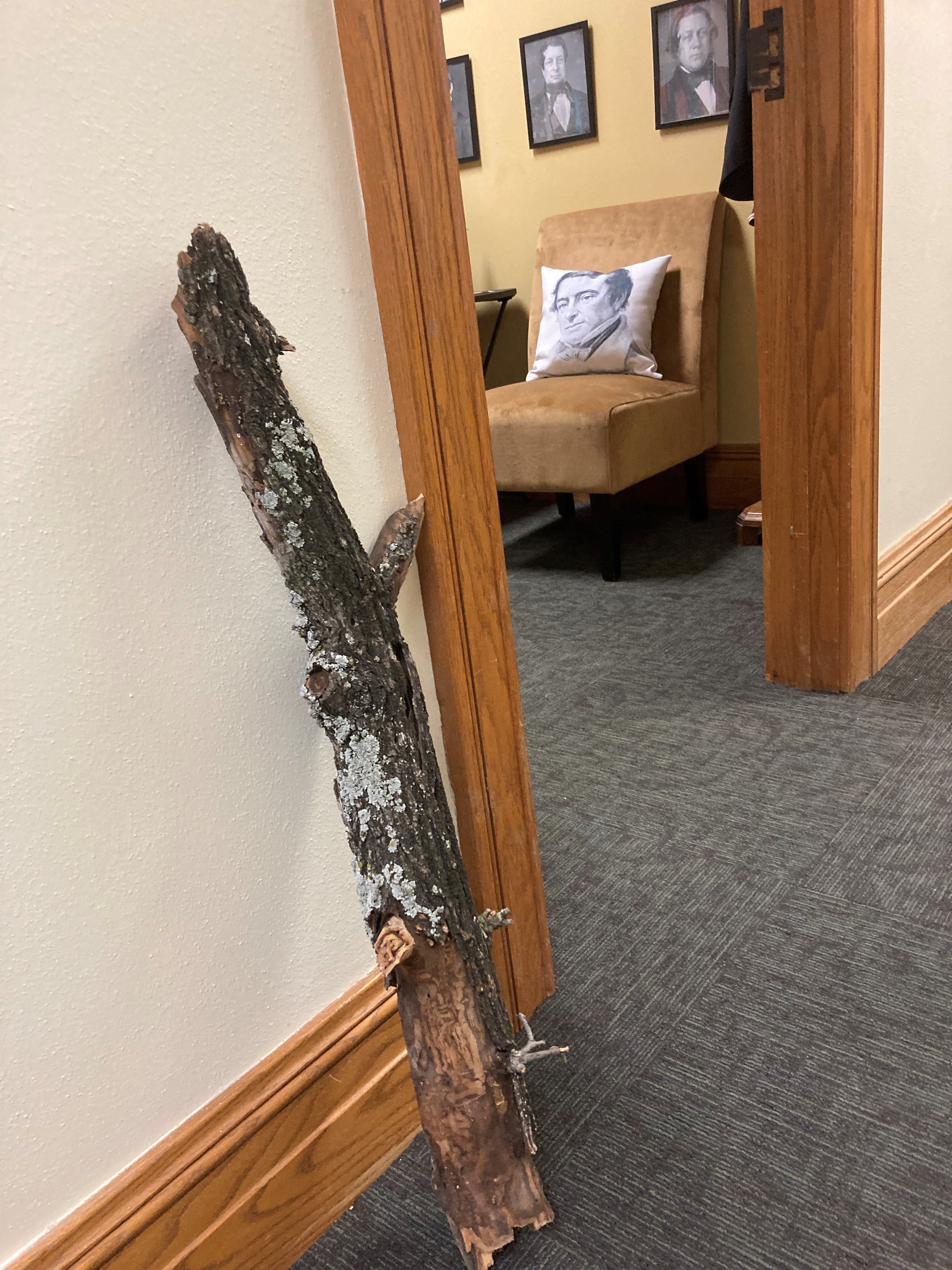
This log has camped out near my office for the past week. (And yes, that’s Washington Irving decor in my office.) Photo by Tracy Hoffman

Wednesday, November 12, 2025

BY TRACY HOFFMAN

My Washington Irving class completed our reading of A Tour on the Prairies today. If some of you were working through the text along with us, congratulations! We made it to Chapter 35.

I would like to thank Cheryl Weaver for crafting two wonderful blogs during the Halloween season while teaching “The Legend of Sleepy Hollow.” She gave me a few weeks to catch up, and it was better to hear about “Sleepy Hollow” during October than Irving’s buffalo hunt. Thank you, Cheryl. You’re awesome!

In the next few weeks, I’ll try to touch on themes my class discussed on our adventure through Oklahoma Territory with Washington Irving, but for today, I want to focus on one overall idea we used in the classroom–chautauqua.

The class concluded our study with a Zoom chat featuring Dr. John Dennis Anderson, who performs as Washington Irving. Another special thanks goes out to John for spending time with us today. Thank you! Thank you! John told the class how fortunate they were to have Dr. Hoffman as their instructor, and I reminded them of how lucky they were to have John Anderson join them for a conversation.

Awhile back, after having my class watch John’s performance on YouTube, I decided to experiment with chautauqua in the classroom. As I told John later, he makes it look easy, but it’s not that easy. Despite the challenges, the experience was still a fun classroom experiment. I would highly recommend teachers of literature apply such a technique to their teaching repertoire.

At the beginning of our journey through Irving’s book, I assigned each student one of the following characters or people groups. Their goal was to focus on these folks during the readings and be prepared to report on the assigned characters for upcoming reading quizzes:

  1. Washington Irving, the narrator
  2. Swiss Count (Albert-Alexandre de Pourtalés)
  3. Mr. L (Charles Latrobe)
  4. Commissioner/Rangers
  5. Tribes
  6. Settlers
  7. Antoine (not Tonish)
  8. Tonish (Antoine)
  9. Pierre Beatte

I’ve done this sort of thing before, most often when I teach Amy Tan’s Joy Luck Club. Following one of the four mothers or one of the four daughters works great for keeping up with the very detailed reading. Anyhow, beyond a close reading of characters, I added a chautauqua component.

Instead of giving students a quiz at the beginning of class to check their reading, I gave the quiz at the end of class, after we had chatted about the reading, from each character’s vantage point. It was uncomfortable at first, but I forced everybody to do their best to get into character, to have a conversation as if your characters were sharing “round the campfire,” like Irving and his companions spend their evenings on the prairies talking about the day’s events.

For a performance, John Anderson typically appears in character for the greater portion of his time and then steps out of character for the final part. However, my students and I were not able to stay in character for long. We found ourselves wanting to step aside and add commentary and ask questions, so we simply modified the process to flow in and out of character as needed.

For three classes, we followed a chautauqua-style conversation, which forced students to move their chairs, get out of the regular rows, and face me and each other. This shook a few of my “back row Baptist” students into a more significant role in the conversation. I really enjoyed hearing these students open up, and I hope they enjoyed playing a greater role in our chats.

For three classes in a row, I added to our makeshift “campfire.” At first, it was only an old Baylor popcorn can with construction-paper cut into flame-shaped shards of red, yellow, and brown.  I’ve heard tissue paper works better, but I didn’t have any of that on hand.

On Wednesday of last week, I exited my car, after arriving on campus, and immediately spotted a nice log—a branch which had obviously fallen during recent storms. I carefully lugged it to my office, where it sat in the hallway until class time. One of my colleagues passed by my office that day and said, “I like your log,” and kept walking.

One of my friends over the weekend said we needed smores, but I said no, since Irving had zero smores on the prairies. He did, however, have brown sugar with his black coffee. I scrounged up a canister of Folgers from the faculty lounge, but my personal coffee maker needed cleaning before sharing it with students. Next time I teach the book, I’ll be sure to reenact all the coffee drinking, which I appreciate.

My students told me we needed rocks to properly set up a campfire, so I “borrowed” a bag full of rocks from a lovely flower bed. (Hopefully, my HOA didn’t notice my digging in the flower beds on the security camera.) My students weren’t fans of the rocks I gathered, since they weren’t big enough to enclose a real campfire. Again, I have goals for the next time I teach the book.

It’s getting late, and I still need to return the rocks to their proper home, so I’ll stop for now. I’ll catch you next week for more debriefing about Irving’s Tour on the Prairies. Until then, you can check out one of John’s performances: https://www.youtube.com/watch?v=XXCoEwa2dqk

Pedagogy on the Prairie: Preparing to Teach Irving’s Western Narratives

AI-Generated in WordPress

Wednesday, October 22, 2025

BY TRACY HOFFMAN

Over the weekend, I attended the ALA Symposium in Santa Fe, and gave a paper, “A Tour of Pedagogy with Washington Irving,” on a Genre Pedagogy panel with colleagues from Baylor. We were pleased with how the panel went, and are considering next steps for the material.

After taking the road trip from Waco to Santa Fe, and back, stopping at the grave of Billy the Kid, I’m ready to get moving on Irving’s western narratives. Next week, my Washington Irving class begins reading A Tour on the Prairies (1835). We’re taking it slowly, doing a much closer reading of Irving, as this will be the one text we read from cover to cover.

And I literally mean cover to cover. Today, I managed to give all my students a hard copy of the book, in a variety of shapes and sizes. I’m especially thankful all my Amazon orders arrived on time, and in good shape. Students seemed pleased with the latest edition to their library collections, but we’ll see how the reading goes in the weeks ahead. We’ll be working through the readings as they finish up Literature Reviews/Annotated Bibliographies and Alternative Reality Game (ARG) projects, due before Thanksgiving.

In case you’re interested, here’s our breakdown for the reading of A Tour on the Prairies:

Monday, 10-27 Chapters 1-5
Wednesday, 10-29Chapters 6-10
Monday, 11-03Chapters 11-15
Wednesday, 11-05 Chapters 16-20
Monday, 11-10Chapters 21-25
Wednesday, 11-12Chapters 26-35

As we move through the material, I’ll be sure to share on Washington Irving Wednesdays what we noticed, uncovered, and discussed. If you have any tips on the text, please feel free to comment. I’ve taught the book many times, but it’s been awhile. I’m looking forward to fresh lesson plans and updated conversations about Irving’s trip to Oklahoma Territory.