Pedagogy of Chautauqua: “Round the Campfire” Conversations about Irving’s Tour on the Prairies

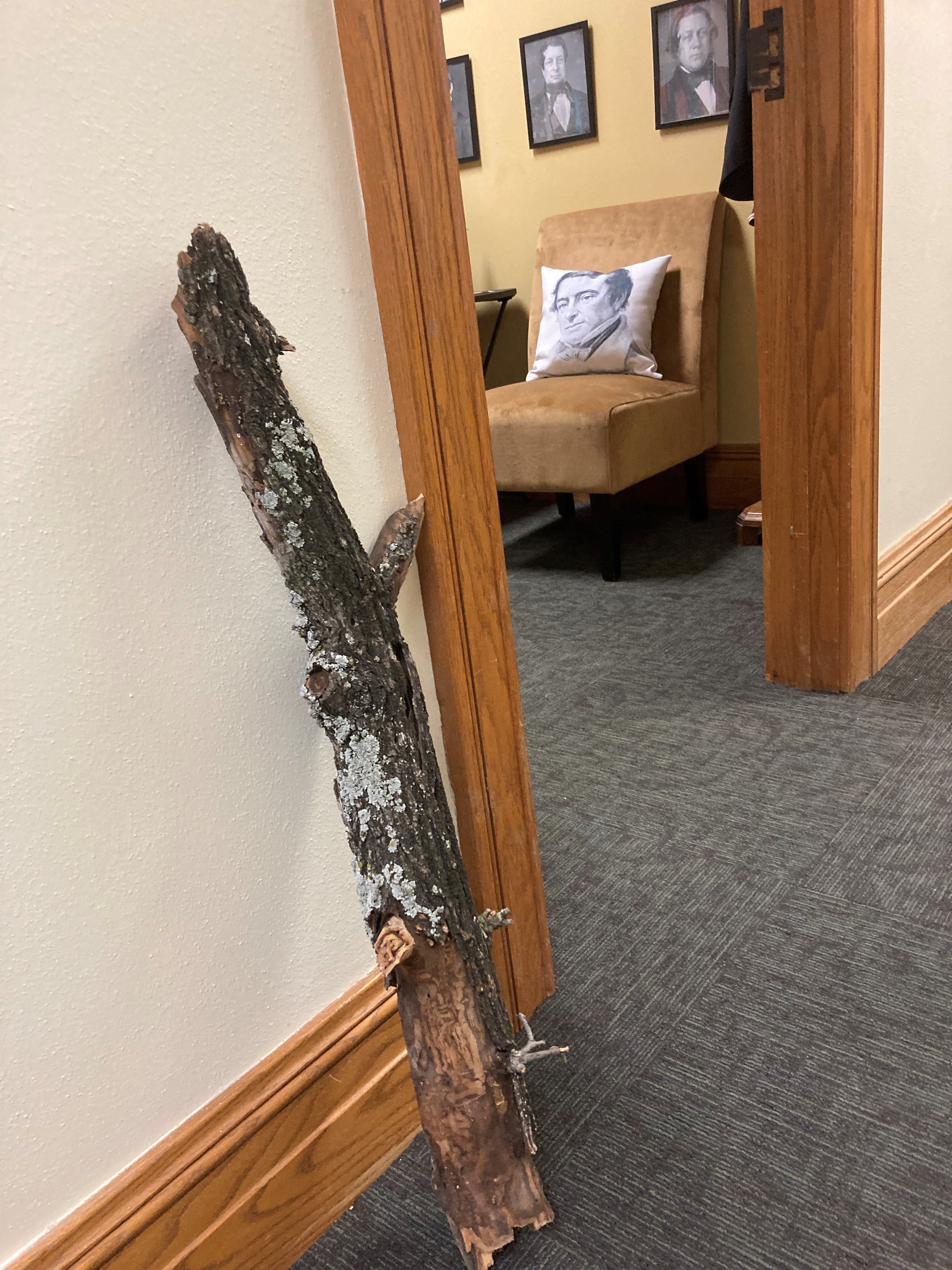
This log has camped out near my office for the past week. (And yes, that’s Washington Irving decor in my office.) Photo by Tracy Hoffman

Wednesday, November 12, 2025

BY TRACY HOFFMAN

My Washington Irving class completed our reading of A Tour on the Prairies today. If some of you were working through the text along with us, congratulations! We made it to Chapter 35.

I would like to thank Cheryl Weaver for crafting two wonderful blogs during the Halloween season while teaching “The Legend of Sleepy Hollow.” She gave me a few weeks to catch up, and it was better to hear about “Sleepy Hollow” during October than Irving’s buffalo hunt. Thank you, Cheryl. You’re awesome!

In the next few weeks, I’ll try to touch on themes my class discussed on our adventure through Oklahoma Territory with Washington Irving, but for today, I want to focus on one overall idea we used in the classroom–chautauqua.

The class concluded our study with a Zoom chat featuring Dr. John Dennis Anderson, who performs as Washington Irving. Another special thanks goes out to John for spending time with us today. Thank you! Thank you! John told the class how fortunate they were to have Dr. Hoffman as their instructor, and I reminded them of how lucky they were to have John Anderson join them for a conversation.

Awhile back, after having my class watch John’s performance on YouTube, I decided to experiment with chautauqua in the classroom. As I told John later, he makes it look easy, but it’s not that easy. Despite the challenges, the experience was still a fun classroom experiment. I would highly recommend teachers of literature apply such a technique to their teaching repertoire.

At the beginning of our journey through Irving’s book, I assigned each student one of the following characters or people groups. Their goal was to focus on these folks during the readings and be prepared to report on the assigned characters for upcoming reading quizzes:

  1. Washington Irving, the narrator
  2. Swiss Count (Albert-Alexandre de Pourtalés)
  3. Mr. L (Charles Latrobe)
  4. Commissioner/Rangers
  5. Tribes
  6. Settlers
  7. Antoine (not Tonish)
  8. Tonish (Antoine)
  9. Pierre Beatte

I’ve done this sort of thing before, most often when I teach Amy Tan’s Joy Luck Club. Following one of the four mothers or one of the four daughters works great for keeping up with the very detailed reading. Anyhow, beyond a close reading of characters, I added a chautauqua component.

Instead of giving students a quiz at the beginning of class to check their reading, I gave the quiz at the end of class, after we had chatted about the reading, from each character’s vantage point. It was uncomfortable at first, but I forced everybody to do their best to get into character, to have a conversation as if your characters were sharing “round the campfire,” like Irving and his companions spend their evenings on the prairies talking about the day’s events.

For a performance, John Anderson typically appears in character for the greater portion of his time and then steps out of character for the final part. However, my students and I were not able to stay in character for long. We found ourselves wanting to step aside and add commentary and ask questions, so we simply modified the process to flow in and out of character as needed.

For three classes, we followed a chautauqua-style conversation, which forced students to move their chairs, get out of the regular rows, and face me and each other. This shook a few of my “back row Baptist” students into a more significant role in the conversation. I really enjoyed hearing these students open up, and I hope they enjoyed playing a greater role in our chats.

For three classes in a row, I added to our makeshift “campfire.” At first, it was only an old Baylor popcorn can with construction-paper cut into flame-shaped shards of red, yellow, and brown.  I’ve heard tissue paper works better, but I didn’t have any of that on hand.

On Wednesday of last week, I exited my car, after arriving on campus, and immediately spotted a nice log—a branch which had obviously fallen during recent storms. I carefully lugged it to my office, where it sat in the hallway until class time. One of my colleagues passed by my office that day and said, “I like your log,” and kept walking.

One of my friends over the weekend said we needed smores, but I said no, since Irving had zero smores on the prairies. He did, however, have brown sugar with his black coffee. I scrounged up a canister of Folgers from the faculty lounge, but my personal coffee maker needed cleaning before sharing it with students. Next time I teach the book, I’ll be sure to reenact all the coffee drinking, which I appreciate.

My students told me we needed rocks to properly set up a campfire, so I “borrowed” a bag full of rocks from a lovely flower bed. (Hopefully, my HOA didn’t notice my digging in the flower beds on the security camera.) My students weren’t fans of the rocks I gathered, since they weren’t big enough to enclose a real campfire. Again, I have goals for the next time I teach the book.

It’s getting late, and I still need to return the rocks to their proper home, so I’ll stop for now. I’ll catch you next week for more debriefing about Irving’s Tour on the Prairies. Until then, you can check out one of John’s performances: https://www.youtube.com/watch?v=XXCoEwa2dqk

Teaching “The Legend of Sleepy Hollow” in the High School Classroom

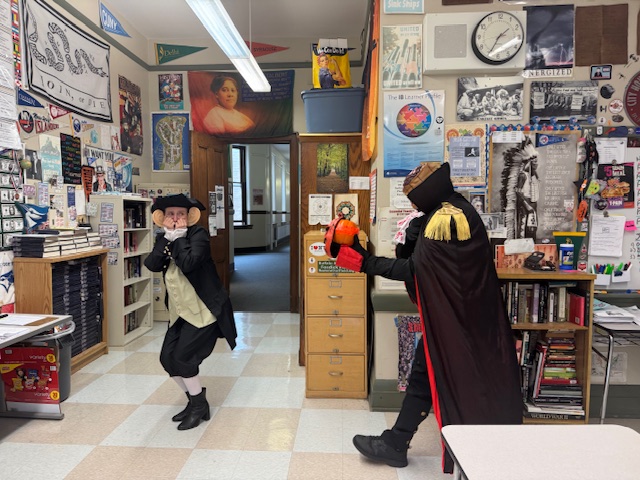
2025 Halloween photo of myself as Ichabod Crane with the AP U.S. History teacher as the Headless Horseman

November 5, 2025

BY CHERYL WEAVER

“Irving is really haunting the text!”
—11th-grade student after class

I was initially uncertain about how to teach this text. Irving’s work had never appeared in any anthologies my district provided, and I hadn’t encountered Irving—at least in my memory (a Rip Van Winkle moment?)—until graduate school. I developed three main instructional objectives:

  • Thematic: The story serves as part of the narrative of a new nation, emphasizing identity as beyond the individual and situated within societal constructs.
  • Comprehension: Focus on Irving’s detailed descriptions of characters and settings, helping students understand why he invested so heavily in these descriptions.
  • Vocabulary: After reviewing the story, I identified a few words that might require additional support for my students.

Here’s an overview of the short plan I developed, incorporating various activities:

Day 1: Students were tired from taking the PSAT in the morning, so to introduce the story, I showed the 1949 Disney adaptation. We used a short worksheet to explore questions about the post-WW2 context and what this adaptation reveals about the United States at that time.

Days 2-4: I gave a brief PowerPoint presentation on Irving and began reading the story with the students. Using an “I do, we do, you do” approach, I read and annotated the text on the first day, having students note brief subtopics for each paragraph. This helped them practice organizing their writing. On the second day, we annotated together, and on the third day, students read and annotated a section individually. We concluded with a 20-question multiple-choice assessment to gauge their understanding and identify areas needing review.

On the last day, Halloween, I read the story’s conclusion dressed as Ichabod Crane. To strengthen cross-curricular connections, this unit aligned with the students’ AP U.S. History studies; their history teacher dressed as the Headless Horseman!

To further engage students and assess their understanding of the text’s connections, we started two class days with a game I designed. Topics included natural imagery, real and fictional characters, settings, and vocabulary, specifically focusing on last names and the term “cognomen” from “The Legend of Sleepy Hollow.”

Overall, students enjoyed the unit and made insightful connections between Irving’s role in crafting history and identity for the newly formed nation. One student remarked, “Irving is really haunting the text!”

Now, I’m beginning to introduce “Rip Van Winkle,” aiming for a culminating project where students can choose between a creative writing option, a traditional analysis essay, or a visual design incorporating elements of Irving’s story and themes.

I eagerly anticipate sharing my students’ creations with you!

Ichabod Crane in the Twenty-First Century High School Classroom

Photo by Cheryl Weaver

October 29, 2025

BY CHERYL WEAVER

“That all this might not be too onerous on…his rustic patrons, who are apt to consider…schoolmasters as mere drones.”

The first time I encountered Irving’s work—aside from vague childhood memories of Disney’s 1949 The Adventures of Ichabod and Mr. Toad and my young adult adoration of Tim Burton’s 1999 Sleepy Hollow—I sat enthralled as my graduate school American Lit professor regaled me with Irving’s importance. Who knew, I thought, as I considered the context of Irving’s Rip Van Winkle, that Irving’s project played such a role in creating an American cultural identity? Roughly ten years later, my interest in Irving reignited when I was awarded a fellowship through the Women’s History Institute at Historic Hudson Valley. My research centered on women’s letters and the United States Post Office, but archivist Catalina Hannan’s knowledge and enthusiasm for Irving piqued my interest once again.

At the May ALA conference, I attended a panel hosted by the Washington Irving Society and met the Society’s President, Tracy Hoffman. We spoke briefly at the WIS Business Meeting: she, thinking ahead about the direction of the Society, and I, puzzling out how I could contribute, turned to pedagogy—not an altogether drastic turn considering Ichabod Crane’s occupation. We made tentative plans to develop instructional materials and methods for engaging learners of all academic levels in the serious study of the author. Ideas began percolating in my mind about how I could fit Irving thematically into my current curriculum.

I teach Language and Literature at a public high school boasting a robust International Baccalaureate program. My students are academically successful, with the expected mischievous nature of young people. (There are a few young Brom Boneses in my midst—harmless, though boisterous.) I needed to hatch a plan to cover the author and share my own adoration of his work. But I had some fundamental questions to consider first.

What exactly do my high school students know about Irving? Sure, most are familiar with the broad strokes—a headless man atop a strong steed, knife in hand, roaring and galloping toward his frightened object desperate to escape across a bridge. But would they be interested in the original text? Further, how could I frame Irving within the parameters of my course and work on stronger cross-curricular planning?

And then it hit me.

Could I position Washington Irving as America’s first influencer? Could that be a starting point to engage my students in reading Irving’s text? Could my larger curricular focus on identity use Washington to consider individual, regional, and national identities and how those are formed?

Those questions frame the unit I’ve just begun on Irving’s stories, timed to coincide with the same historical period in my students’ course on U.S. History…and Halloween. A few days in, students seem to be receptive (more on that to come!), and I anxiously await their reaction when I appear in class on Friday as Crane before they head to their history class, taught by a certain headless horseman.