Wednesday, December 10, 2025
BY TRACY HOFFMAN
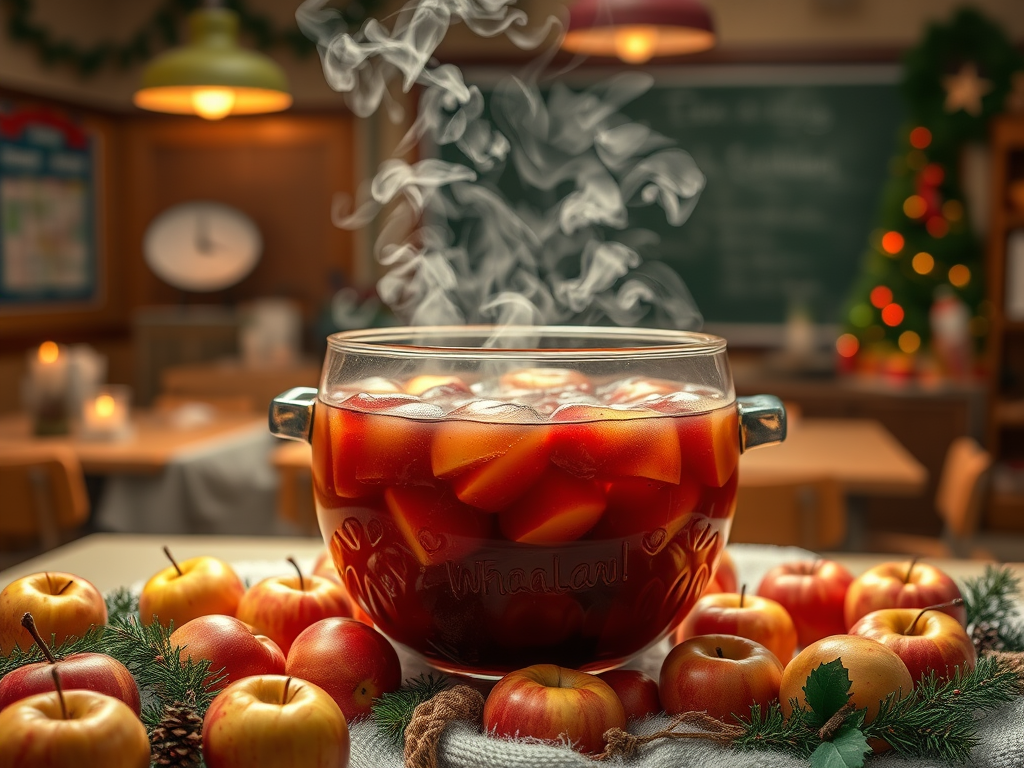
Today, my Washington Irving class finished up our semester together. They still have final exams, and I still have grades to crunch, but today was the last day of classes. To finish off our time together, students worked on blogs, which will soon appear on the Washington Irving Society page, and I also put together a mini Wassail Fest in our classroom.
The wassail bowl is passed around in Washington Irving’s Christmas stories, so it seems appropriate for us to enjoy a similar beverage. Irving writes: “When the cloth was removed, the butler brought in a huge silver vessel of rare and curious workmanship, which he placed before the Squire. Its appearance was hailed with acclamation; being the Wassail Bowl, so renowned in Christmas festivity. The contents had been prepared by the Squire himself; for it was a beverage in the skilful mixture of which he particularly prided himself; alleging that it was too abstruse and complex for the comprehension of an ordinary servant. It was a potation, indeed, that might well make the heart of a toper leap within him; being composed of the richest and raciest wines, highly spiced and sweetened, with roasted apples bobbing about the surface.”
Of course, we didn’t have apples bobbing, nor did we have racy wine.
Irving continues: “The old gentleman’s whole countenance beamed with a serene look of indwelling delight, as he stirred this mighty bowl. Having raised it to his lips, with a hearty wish of a merry Christmas to all present, he sent it brimming round the board, for every one to follow his example, according to the primitive style: pronouncing it ‘the ancient fountain of good feeling, where all hearts met together.'”
We didn’t pass wassail round the room, but I did circulate the room, pouring the samples. Irving calls the wassail “the honest emblem of Christmas joviality.” I’m not quite sure my students felt much “Christmas joviality” as they face finals, but perhaps when they reach the other side of their exams, they will have happy thoughts about our wassailing efforts.
For our Wassail Fest, three students volunteered to make their own versions of wassail, using various combinations of:
- Apples
- Oranges
- Cinnamon
- Nutmeg
- Cloves
- Ginger
- Sugar
- Apple Juice
I brought the fruit, juice, spices, containers, knife, peeler, and measuring spoons. Each contestant assembled a wassail blend, and then I mixed the blend with two cups of 100% apple juice. When the tea kettle cut off, the batch was complete.
We had a taste test and voted, but in the end, all three wassails were excellent. I will be emailing all of our contestants certificates for winning the First Annual Washington Irving Wassail Fest at Baylor University.
The first concoction didn’t have too much spice, so it wasn’t far from apple juice, but still quite good. The second one was a little more spicy, and also quite good. And the final beverage included extra sugar, so we all agreed the sugar made the spices pop. I felt like it would be a good beverage if you had a cold. It seemed like it could awaken all the senses, though the sugar content probably wouldn’t be so great if you were sick.
One student was allergic to cinnamon, so she couldn’t participate. I’ve had students allergic to peanuts, so I’m accustomed to leaving nuts out of most anything I bring to class, but someone being allergic to spices never crossed my mind. Fortunately, the smell of cinnamon is okay. She just couldn’t ingest it. Everybody agreed the classroom smelled like Christmas after we started brewing our beverages.
In fact, one student who had recently recovered from a nasal infection was excited to realize she could now smell! Her olfactory system hadn’t been working properly, but the power of wassail returned her sense of smell.
Smelling cinnamon makes me happy, too. I remember sniffing cinnamon every morning the one time I had Covid in 2022. I monitored the situation with cinnamon, ginger, and coffee smell checks. I was happy that very first time I could smell cinnamon once again, and that happiness hits me again when I get a whiff of it.
At some point over the holiday break, I’ll put all the ingredients in a big pot on the stove to make my home smell like Christmas, too. And, of course, the wassail tastes much better after simmering on the stove for awhile, instead of quickly boiling in a tea kettle, like we did in the classroom.
I’m aware of at least three major Wassail Fests in Texas: San Marcos, Denton, and Paris. A few of these have already happened, but the Paris event is scheduled for this weekend. I may give it a go:
https://business.paristexas.com/events/details/14th-annual-wassail-fest-19657
And here’s the audio recording of today’s blog:



 Washington Irving Society