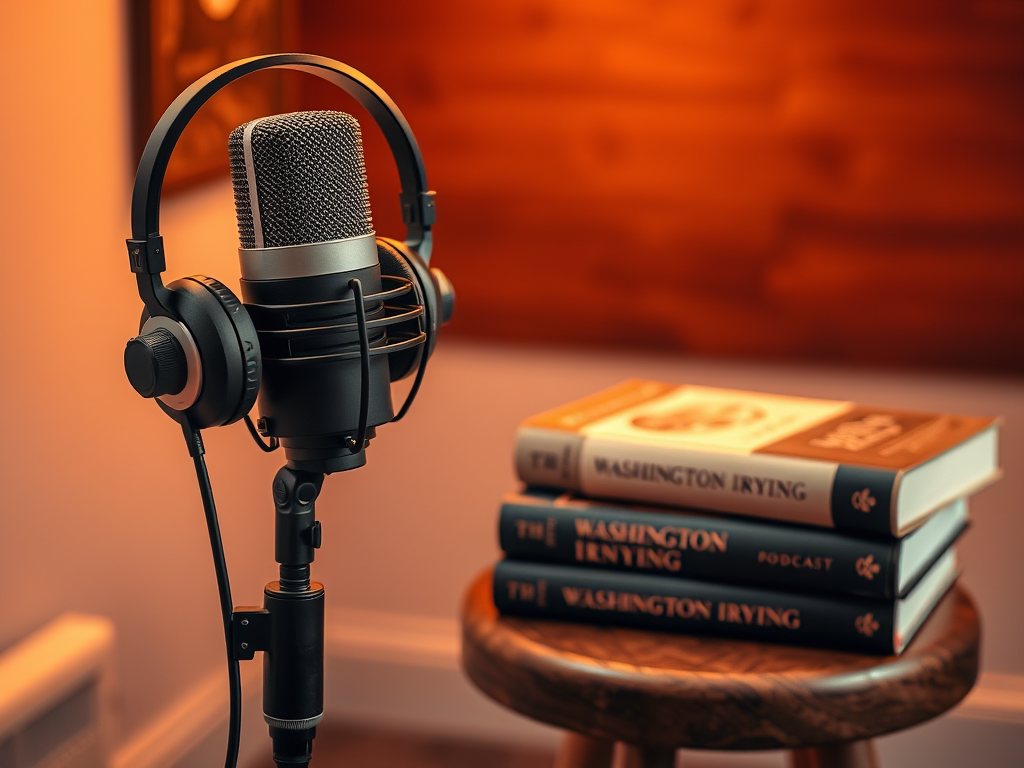
“Spilling the Tea” on Washington Irving: Podcasting Considerations

AI-generated photo, created in WordPress

Wednesday, December 3, 2025

BY TRACY HOFFMAN

This week my American Literature classes wrapped up podcasting for the semester. I could have talked for hours about several of the questions raised during their podcast presentations. Four students pretended to be the four daughters of The Joy Luck Club. They “spilled the tea” on all the gossip in the novel. Another podcast team took a more serious slant, working through ideas about the American Dream.

Their creativity amazes me. Students who are seemingly shy during a regular class often come to life when given a platform and a microphone. It’s a treat to see how talented and interesting each and every student happens to be. They wouldn’t be at Baylor in the first place if they weren’t terrific, but when it’s podcast time, I really get to see their talents shine bright.

My students have been doing podcasts for my classes since Fall 2019, so we’ve been working through the process for six years now. We’ve recorded in the library’s podcast studios, on my laptop with a nano microphone, on cell phones, and Zoom recordings. We’ve edited, not edited, recorded live in the classroom, and recorded individually from home.

And I upload their recordings into Canvas, our learning management system. I enjoy relistening to the podcasts on my drives back home to Fort Worth from Waco. But what has been a private conversation, available only to students enrolled in my classes, might be an opportunity to share with the world what we manage to bring together throughout the course of a semester, in a literature class, at Baylor University. But I haven’t taken that step.

Knowing what I now know about my students and all the exceptional content they’ve created, I realize we, the Washington Irving Society, needs to get more audio content out there about our guy.

When I checked the stats recently on this WordPress page, I learned the most popular blog I’ve posted lately happens to be the Washington Irving playlist my students put together. I told them today in our Irving class. They seemed pleased.

But this fact, combined with all my students’ podcasting efforts, makes me see how important audio can and should be for our Irving efforts.

Ironically, at this very moment, as I’m typing this blog, I can’t concentrate because of the noise coming from outside my office door. The vacuum cleaner has been going for awhile now, as the cleaning staff works on my floor. After looking around online for royalty-free podcast music to launch the intro to a potential podcast, I’m tempted to record vacuum sounds.

And on that note, I’ll close this blog. But please know, I honestly do want to get a podcast or two or three or four out there soon. Perhaps I could record a set of four over the Christmas break.

Teaching “The Legend of Sleepy Hollow” in the High School Classroom

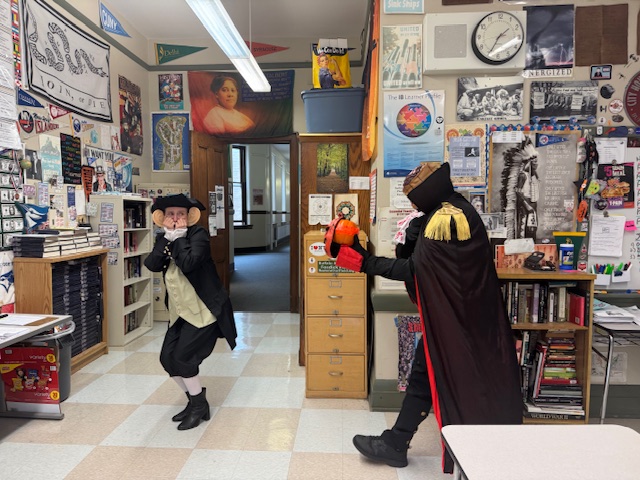
2025 Halloween photo of myself as Ichabod Crane with the AP U.S. History teacher as the Headless Horseman

November 5, 2025

BY CHERYL WEAVER

“Irving is really haunting the text!”
—11th-grade student after class

I was initially uncertain about how to teach this text. Irving’s work had never appeared in any anthologies my district provided, and I hadn’t encountered Irving—at least in my memory (a Rip Van Winkle moment?)—until graduate school. I developed three main instructional objectives:

  • Thematic: The story serves as part of the narrative of a new nation, emphasizing identity as beyond the individual and situated within societal constructs.
  • Comprehension: Focus on Irving’s detailed descriptions of characters and settings, helping students understand why he invested so heavily in these descriptions.
  • Vocabulary: After reviewing the story, I identified a few words that might require additional support for my students.

Here’s an overview of the short plan I developed, incorporating various activities:

Day 1: Students were tired from taking the PSAT in the morning, so to introduce the story, I showed the 1949 Disney adaptation. We used a short worksheet to explore questions about the post-WW2 context and what this adaptation reveals about the United States at that time.

Days 2-4: I gave a brief PowerPoint presentation on Irving and began reading the story with the students. Using an “I do, we do, you do” approach, I read and annotated the text on the first day, having students note brief subtopics for each paragraph. This helped them practice organizing their writing. On the second day, we annotated together, and on the third day, students read and annotated a section individually. We concluded with a 20-question multiple-choice assessment to gauge their understanding and identify areas needing review.

On the last day, Halloween, I read the story’s conclusion dressed as Ichabod Crane. To strengthen cross-curricular connections, this unit aligned with the students’ AP U.S. History studies; their history teacher dressed as the Headless Horseman!

To further engage students and assess their understanding of the text’s connections, we started two class days with a game I designed. Topics included natural imagery, real and fictional characters, settings, and vocabulary, specifically focusing on last names and the term “cognomen” from “The Legend of Sleepy Hollow.”

Overall, students enjoyed the unit and made insightful connections between Irving’s role in crafting history and identity for the newly formed nation. One student remarked, “Irving is really haunting the text!”

Now, I’m beginning to introduce “Rip Van Winkle,” aiming for a culminating project where students can choose between a creative writing option, a traditional analysis essay, or a visual design incorporating elements of Irving’s story and themes.

I eagerly anticipate sharing my students’ creations with you!