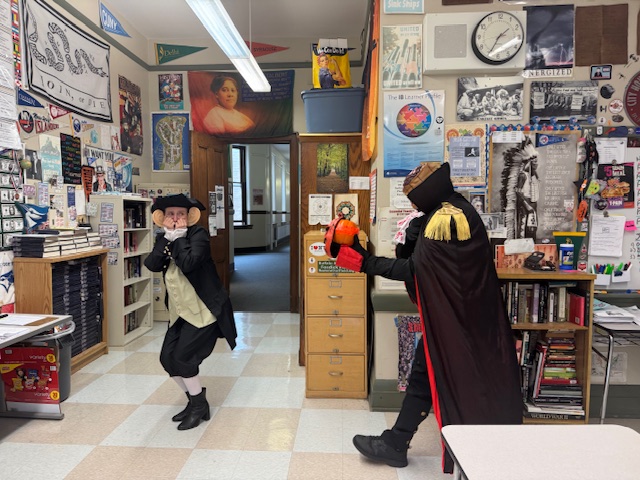
2025 Halloween photo of myself as Ichabod Crane with the AP U.S. History teacher as the Headless Horseman
November 5, 2025
BY CHERYL WEAVER
“Irving is really haunting the text!” —11th-grade student after class
I was initially uncertain about how to teach this text. Irving’s work had never appeared in any anthologies my district provided, and I hadn’t encountered Irving—at least in my memory (a Rip Van Winkle moment?)—until graduate school. I developed three main instructional objectives:
Thematic: The story serves as part of the narrative of a new nation, emphasizing identity as beyond the individual and situated within societal constructs.
Comprehension: Focus on Irving’s detailed descriptions of characters and settings, helping students understand why he invested so heavily in these descriptions.
Vocabulary: After reviewing the story, I identified a few words that might require additional support for my students.
Here’s an overview of the short plan I developed, incorporating various activities:
Day 1: Students were tired from taking the PSAT in the morning, so to introduce the story, I showed the 1949 Disney adaptation. We used a short worksheet to explore questions about the post-WW2 context and what this adaptation reveals about the United States at that time.
Days 2-4: I gave a brief PowerPoint presentation on Irving and began reading the story with the students. Using an “I do, we do, you do” approach, I read and annotated the text on the first day, having students note brief subtopics for each paragraph. This helped them practice organizing their writing. On the second day, we annotated together, and on the third day, students read and annotated a section individually. We concluded with a 20-question multiple-choice assessment to gauge their understanding and identify areas needing review.
On the last day, Halloween, I read the story’s conclusion dressed as Ichabod Crane. To strengthen cross-curricular connections, this unit aligned with the students’ AP U.S. History studies; their history teacher dressed as the Headless Horseman!
To further engage students and assess their understanding of the text’s connections, we started two class days with a game I designed. Topics included natural imagery, real and fictional characters, settings, and vocabulary, specifically focusing on last names and the term “cognomen” from “The Legend of Sleepy Hollow.”
Overall, students enjoyed the unit and made insightful connections between Irving’s role in crafting history and identity for the newly formed nation. One student remarked, “Irving is really haunting the text!”
Now, I’m beginning to introduce “Rip Van Winkle,” aiming for a culminating project where students can choose between a creative writing option, a traditional analysis essay, or a visual design incorporating elements of Irving’s story and themes.
I eagerly anticipate sharing my students’ creations with you!
The obvious choice for launching a conversation about pedagogy and Washington Irving would be “the worthy pedagogue,” Ichabod Crane. In fact, our Sleepy Hollow superstar of pedagogy could probably keep me busy blogging for the rest of 2025.
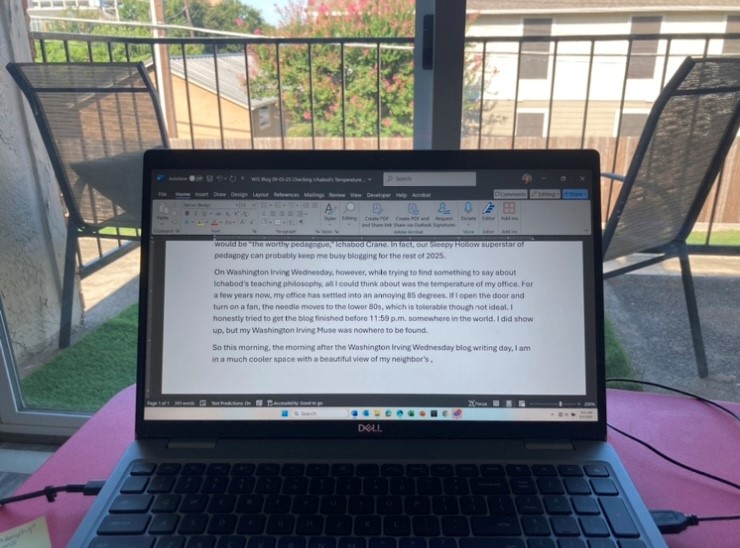
On Washington Irving Wednesday, however, while trying to find something to say about Ichabod’s teaching, all I could think about was the temperature of my office. For a few years now, my office on campus has settled into an annoying 85 degrees. If I open the door, turn on a fan, and keep the lights off, the needle moves to the lower 80s, which is tolerable though not ideal. I honestly tried to get this blog finished before 11:59 p.m. somewhere in the world. I did show up and began writing, but my Washington Irving Muse was too hot and bothered to offer much assistance.
This Thursday morning, the morning after Washington Irving Wednesday, I am in a much cooler space with a pretty view of blue skies and hot pink crepe myrtle bushes. I apologize for posting Thursday, instead of Wednesday, but I didn’t feel comfortable sharing all the pedagogical thoughts going through my head last night about the “thermal comfort” of “educational buildings” negatively impacting mental health. (Can you tell I was digressing into scholarly articles about architecture, psychology, and more?) My thoughts and the temperature were out of control, so I shut everything down at 8:30 p.m. Texas time. I’m in a much better space, mentally and physically, this morning.
A few nights ago, I re-read “The Legend of Sleepy Hollow” since my undergraduate students this week have been reading it, along with “Rip Van Winkle,” and “Philip of Pokanoket.” My intent was to notice everything related to teaching, which allowed me to consider some passages I haven’t thought about in a while, or ever. I’ll do my best to unpack a few ideas today, think about Ichabod Crane over the weekend (which sounds like a very odd thing to do), and pick up my thoughts again next week.
What struck me most a few days ago, and what jumps out to me now, after my evening with “climate control” pedagogy, include:
Abandoned, haunted schoolhouse
School as empire
Burning of Ichabod’s books
Educational connection to “Tarry” in Tarrytown
Ichabod Crane’s mental health
Marrying Katrina to get out of the teaching profession
Bachelorhood as a negative detachment from community
Moral of the story
After Ichabod’s disappearance, we learn since “he was a bachelor, and in nobody’s debt, nobody troubled his head any more about him, the school was removed to a different quarter of the hollow, and another pedagogue reigned in his stead” (1086*). And, right prior to the Postscript, Irving writes: “The schoolhouse being deserted, soon fell to decay, and was reported to be haunted by the ghost of the unfortunate pedagogue; and the plough boy, loitering homeward of a still summer evening, has often fancied his voice at a distance, chanting a melancholy psalm tune among the tranquil solitudes of Sleepy Hollow” (1087).
Much like the headless horseman who haunts Sleepy Hollow, Irving suggests Ichabod may haunt the area, too. Instead of roaring through town on a late-night ride, though, Ichabod Crane sings his way around the schoolhouse.
Singing? Do we have any other ghosts in American Literature who sing? He’s a Singing Connecticut Yankee Ghost. Any of those on the American stage? I’ll have to investigate the matter. A few of my colleagues may know a thing or two about that.
To be honest, I’ve never thought much about the haunting of the schoolhouse, the “educational building” of the town, to use jargon I picked up on my brief journey through architecture research last night. We typically think of the Old Dutch Church and the Church Bridge as central physical structures in the story, which could open up a conversation about faith, but the abandoned schoolhouse further pushes the idea of Ichabod Crane abandoning his spaces and belongings, and begs for an educational interpretation. Just as the “gazers and gossips…came to the conclusion, that Ichabod had been carried off by the galloping Hessian” (1086), the school, too, is “carried off” to a more agreeable location.
Midway through the story, Brom Bones plots practical jokes against Ichabod, making good use of the schoolhouse: “Ichabod became the object of whimsical persecution to Bones, and his gang of rough riders. They harried his hitherto peaceful domains; smoked out his singing school, by stopping up the chimney; broke into the school house at night, in spite of its formidable fastenings of withe and window stakes, and turned every thing topsy-turvy, so that the poor schoolmaster began to think all the witches in the country held their meetings there” (1071-72).
Not only does Ichabod Crane have to deal with Brom’s antics, but he also battles “evil doers” at the schoolhouse. Irving writes: “On a fine autumnal afternoon, Ichabod, in pensive mood, sat enthroned on the lofty stool from when he usually watched all the concerns of his little literary realm. In his hand he swayed a ferule, that sceptre of despotic power, the birch of justice reposed on three nails, behind the throne, a constant terror to evil doers; while on the desk before him might be seen sundry contraband articles and prohibited weapons, detected upon the persons of idle urchins, such as half munched apples, popguns, whirligigs, fly cages, and whole legions of rampant little paper game cocks” (1072).
The weaponry students use interests me. I’m not sure exactly what I might have to say about all the paraphernalia he gathers from them, but Ichabod accumulates sordid things, as evidenced by his personal collection of strange belongings left behind in a handkerchief when he vanishes.
And on that note, let me stop these ramblings and vanish from this week’s blog post. I’ll be back next week, God willing on Wednesday with clearer thoughts, to continue the conversation about pedagogy and Irving.
* Irving quotes are from the Library of America, published in 1983.


 Washington Irving Society