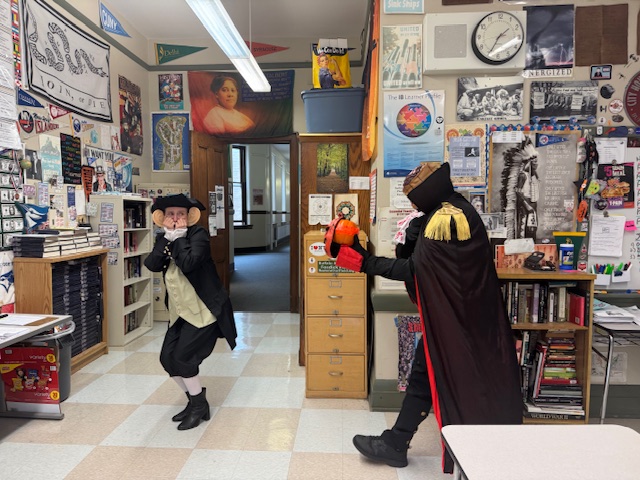
2025 Halloween photo of myself as Ichabod Crane with the AP U.S. History teacher as the Headless Horseman
November 5, 2025
BY CHERYL WEAVER
“Irving is really haunting the text!” —11th-grade student after class
I was initially uncertain about how to teach this text. Irving’s work had never appeared in any anthologies my district provided, and I hadn’t encountered Irving—at least in my memory (a Rip Van Winkle moment?)—until graduate school. I developed three main instructional objectives:
Thematic: The story serves as part of the narrative of a new nation, emphasizing identity as beyond the individual and situated within societal constructs.
Comprehension: Focus on Irving’s detailed descriptions of characters and settings, helping students understand why he invested so heavily in these descriptions.
Vocabulary: After reviewing the story, I identified a few words that might require additional support for my students.
Here’s an overview of the short plan I developed, incorporating various activities:
Day 1: Students were tired from taking the PSAT in the morning, so to introduce the story, I showed the 1949 Disney adaptation. We used a short worksheet to explore questions about the post-WW2 context and what this adaptation reveals about the United States at that time.
Days 2-4: I gave a brief PowerPoint presentation on Irving and began reading the story with the students. Using an “I do, we do, you do” approach, I read and annotated the text on the first day, having students note brief subtopics for each paragraph. This helped them practice organizing their writing. On the second day, we annotated together, and on the third day, students read and annotated a section individually. We concluded with a 20-question multiple-choice assessment to gauge their understanding and identify areas needing review.
On the last day, Halloween, I read the story’s conclusion dressed as Ichabod Crane. To strengthen cross-curricular connections, this unit aligned with the students’ AP U.S. History studies; their history teacher dressed as the Headless Horseman!
To further engage students and assess their understanding of the text’s connections, we started two class days with a game I designed. Topics included natural imagery, real and fictional characters, settings, and vocabulary, specifically focusing on last names and the term “cognomen” from “The Legend of Sleepy Hollow.”
Overall, students enjoyed the unit and made insightful connections between Irving’s role in crafting history and identity for the newly formed nation. One student remarked, “Irving is really haunting the text!”
Now, I’m beginning to introduce “Rip Van Winkle,” aiming for a culminating project where students can choose between a creative writing option, a traditional analysis essay, or a visual design incorporating elements of Irving’s story and themes.
I eagerly anticipate sharing my students’ creations with you!
I’m writing this blog, or starting this blog—in my garage, right before pulling away for the two-hour commute to Baylor. I’ll pick up the writing again at red lights, and then finish up at some point this evening after my classes finish at 5:15.
Yesterday, I had high hopes of getting ahead of this Washington Irving Wednesday. But alas! It was 90 degrees in my office, up five degrees from the usual setting. After chatting with a student around 5 p.m., I put a “gone fishing” sign on the door, packed my bags, and headed home—to work. But alas! Yet again, it wasn’t meant to be.
After cruising the I-35 corridor for about 45 minutes, the freeway was shut down by some reason I never discovered, perhaps an accident or a construction-related matter. Anyhow, I graded two batches of quizzes while stopped, and I also learned through texts and phone calls my sister was in the hospital. After the 30-minute delay of sitting on the freeway, and after visiting my sister at the hospital, who will hopefully be home soon, it was 9:15 by the time I finally got home. I needed a shower after sweating through my clothes at the office and after collecting a variety of germs at the hospital. I needed dinner. I needed to work on my blog. But sadly, no work was done.
Fortunately, though, storms woke me around 4 a.m., so I went ahead and got up for coffee and Washington Irving. I decided to read the texts I had assigned from The Sketch Book: “The Wife,” “A Broken Heart,” “Account of the Author,” and “To the Public.” It’s Sentimental Irving Day in my Washington Irving class, and I was ready to chat about our occasionally sentimental “man of letters.”
On Monday, our class tackled satire and persona as I guided them through pedagogy genre. After sharing definitions for satire and persona, we created Billy Bob “Bubba” Cowboy Jones to tell our satirical History of Texas. Personally, I think Cowboys owner Jerry Jones should be honored that Gen Z students think him comparable to Diedrich Knickerbocker. Perhaps one day we’ll have a Texas team called the Jerrys or the Joneses, like New Yorkers have Knickerbockers.
In our conversations about Diedrich Knickerbocker, the passages comparing him to a teacher jumped out to me. For instance, Seth Handaside in the “Account of the Author“ first describes Knickerbocker as: “a small brisk looking old gentleman, dressed in a rusty black coat, a pair of olive velvet breeches, and a small cocked hat. He had a few grey hairs plaited and clubbed behind, and his beard seemed to be of some four and twenty hairs growth. The only piece of finery which he bore about him, was a bright pair of square silver shoe buckles, and all his baggage was contained in a pair of saddle bags which he carried under his arm. His whole appearance was something out of the common run, and my wife, who is a very shrewd body, at once set him down for some eminent country school-master” (373).
The first description we ever see of Diedrich Knickerbocker suggests a teacher. We learn five paragraphs later, in an effort to help Knickerbocker pay his bills, Mrs. Handaside suggests he “teach the children their letters” while she offers “to try her best and get the neighbours to send their children also” (375). However, Knickerbocker “took it in such dudgeon, and seemed so affronted at being taken for a school-master, that she never dared speak on the subject again” (375).*
In class, we spent a little time comparing Diedrich Knickerbocker to Ichabod Crane, and as I’m digging into genre pedagogy and new ways of considering Ichabod, this comparison seems worth pursuing. We watched film clips of both Ichabod and Diedrich, and Irving clearly overlaps physical qualities and character descriptions.
Today, we built upon our conversation from Monday about persona and satire, by adding a sentimental spin to our recent development, Billy Bob “Bubba” Cowboy Jones. We decided his lady should be a New Yorker, so we went with Eugenia, since that’s the name of Jerry Jones’ wife. Bubba falls for Eugenia Knickerbocker, an outsider visiting Texas. She is bitten by a rattlesnake and smitten by Bubba, when he rescues her from the rattler’s venom.
My students also spun yarns about their own research projects, and I look forward to sharing their ARGs (alternative reality games) with you, later this semester.
As this semester progresses, please know we have much going on behind the scenes, beyond my daily angst with commutes and temperature. Cheryl Weaver, who teaches in New York, is working with me on Washington Irving Wednesdays as an unofficial secretary to the Washington Irving Society. Of course, we’ll make it official when we vote for officers at our next 2026 business meeting in Chicago. Cheryl and I met in Boston at the 2025 ALA conference.
Along with Vice-President Sean Keck, Cheryl and I will be putting together our 2026 call for papers. You can probably guess we plan to have two panels on teaching Washington Irving, tentatively titled Pedagogy and Washington Irving Panel One and Pedagogy and Washington Irving Panel Two.
Please watch for the CFPs and also some blogs from Cheryl.
This is Tracy Hoffman, president of the Washington Irving society, signing off until next Wednesday.
*Irving, Washington. History, Tales and Sketches. Library of America. 1983.
When I teach Salmagundi, I always think about bringing a salmagundi salad to class, but then I decide anchovies probably aren’t the best idea. I wouldn’t want anyone to connect our Washington Irving class to a fishy smell.
According to the Oxford English Dictionary, salmagundi consists of “chopped meat, anchovies, eggs, onions with oil and condiments.”* But when I’ve made my version of salmagundi, I tend to avoid any extra “chopped meat.” The anchovies are enough, but you can make it however you like. The idea is a mixed salad, and we all know how to throw together a salad we like.
My class has cruised through the most popular stories: “Rip Van Winkle,” “The Legend of Sleepy Hollow,” “The Devil and Tom Walker,” and the Bracebridge Christmas stories. I wanted to give students a fun, easy way to start the class, and to get everyone on the same page since a handful had already read Irving in previous classes.
With the basics down, this week we began the chronological sampling of Irving’s larger body of work, starting with the Mustapha letters from Salmagundi. The plan is to finish the semester with snippets from the five George Washington volumes. I only assigned students three of the Mustapha letters, but many also ventured into other articles, so I trust everybody got an overall feel for the twenty issues of Salmagundi.
With all that’s going on this Wednesday of 2025, I find myself trying to imagine Washington Irving’s world of 1807, more than a decade before he published “The Legend of Sleepy Hollow.” Instead of continuing to deal with Ichabod Crane’s role as the chief pedagogue, my mind has drifted into the troubling times of Irving’s life while doing earlier periodical work.
According to the Library of America’s chronology, Irving spends 1807-1808 doing the following:
“Co-authors Salmagundi, which receives much praise, with William Irving and James Kirke Paulding.
Is a sympathetic spectator at the trial of Aaron Burr in Richmond.
Makes periodic visits to Philadelphia.
Father dies October 1807; sister Ann Dodge dies May 1808.
Continues to visit the Hoffman household and falls in love with Matilda Hoffman.
With Peter Irving, conceives the idea of a burlesque historical guidebook to New York. Begins work on it June 1808” (1095).**
It’s almost unimaginable to think of losing father and sister in less than a year, all the while falling in love with Matilda Hoffman, who herself passes away, a little later, in the spring of 1809. The country deals with Aaron’s Burr’s charge of treason, and through all of life’s difficulties, Irving co-writes, anonymously, articles for Salmagundi with his brother William and James Kirke Paulding. He also begins work on more satire, as he plans A History of New York.
Today, in class, I wanted to talk about the pedagogy of genre with regard to satire, and to do some writing activities involving different kinds of satire, but I decided to hold that thought until next week when we read portions of A History of New York. Right now, asking students to critique our society in a satirical way feels forced, but I thought mocking the early days of the Republic of Texas next week, alongside Irving’s mocking of New York, would open up a useful application of the genre. I’ll report back next week to let you know how Texas measures up to New York. Until then.
Over the weekend and into this week, I’ve continued thinking about Ichabod Crane as a teacher and ghost.
These ruminations have blended with concerns about A Christmas Carol by Charles Dickens since the beautiful building, which comprises my 85-degree office, will soon be turned into a haunted-house-of-sorts for Scrooge’s ghosts. I will most certainly get around to writing about the impending mayhem in future blogs. Suffice it to say for today, my Ichabod thoughts have been tainted by a foreboding sense of Charles Dickens.
My mental image of Ichabod Crane coexists with pictures of the Dickens’ character Uriah Heep from David Copperfield. Physically, they look the same in my mind’s eye, even though I realize Ichabod is a much livelier character than Uriah. But let me stop myself from going further into the Dickens rabbit hole. (If you want to jump into Elizabeth Bradley’s article, “Dickens and Irving: A Tale of Two Christmas Tales,” you’ll be ready for my future conversations as we get closer to December.)
The big research questions I pose today are:
Is Ichabod Crane the first Connecticut Yankee Pedagogue Ghost in American Literature?
Is Ichabod Crane the first Connecticut Yankee Ghost in American Literature?
Is Ichabod Crane the first Connecticut Yankee Teacher in American Literature?
I think we know the answers to all these questions. American Literature isn’t necessary. Where else would we see a Connecticut Yankee? Yes, of course, he would be the first in all three categories. The first two questions/descriptions are so bizarre and specific, I can’t imagine another character fulfilling them. But my last question has me thinking.
Yes, I believe Ichabod Crane is our first Connecticut Yankee who teaches. But why, in the development of the Connecticut Yankee, did Irving choose to make him a teacher?
Ichabod Crane balances between the Jonathan character of Royal Tyler’s The Contrast (1787) and Hank Morgan of Mark Twain’s Connecticut Yankee in King Arthur’s Court (1889). David Gamut of James Fenimore Cooper’s Last of the Mohicans (1826), appearing a short time after Irving’s character, keeps the role as a music teacher, but Hank Morgan has lost the teaching quality by 1889.
According to Gary Denis, in Sleepy Hollow: Birth of the Legend (2015), Irving transfers some of the stereotypical qualities of the Yankee onto Brom Bones and refines Ichabod’s role to make him an “educated city-slicker” instead of “the country dweller” (158). Denis points to Irving’s improvement: “Irving is thereby credited as having been the first to introduce a conflict between East and West, the refined and cultured Connecticut Yankee vs. the rough-hewn frontiersman” (158).
But I’m still left with—Why? Why did Irving choose a teacher for Ichabod’s profession? We know that the minister and Ichabod Crane are the two most educated fellows in Sleepy Hollow, so I understand the options were limited.
We can study Jesse Merwin, Irving’s teacher friend who inspired the character. And we can consider Ichabod B. Crane, the military officer and inspiration for Ichabod’s name. With more research to investigate, I’ll close the blog out for now. My quest to understand Ichabod Crane, the pedagogue, continues.
Today, my students are reading “The Devil and Tom Walker,” and I can see Dickens borrowing heavily from Irving’s story to benefit his own Christmas Carol, so my blog next Wednesday could easily collapse into my own Dickens’ nightmares.
The obvious choice for launching a conversation about pedagogy and Washington Irving would be “the worthy pedagogue,” Ichabod Crane. In fact, our Sleepy Hollow superstar of pedagogy could probably keep me busy blogging for the rest of 2025.
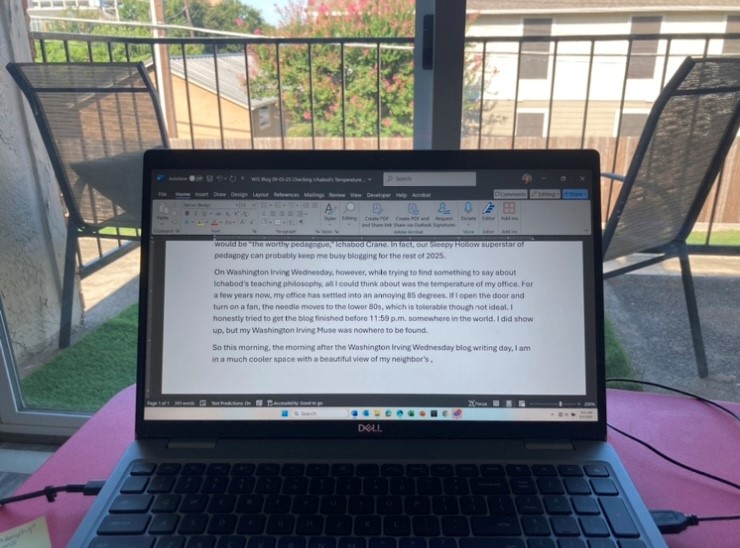
On Washington Irving Wednesday, however, while trying to find something to say about Ichabod’s teaching, all I could think about was the temperature of my office. For a few years now, my office on campus has settled into an annoying 85 degrees. If I open the door, turn on a fan, and keep the lights off, the needle moves to the lower 80s, which is tolerable though not ideal. I honestly tried to get this blog finished before 11:59 p.m. somewhere in the world. I did show up and began writing, but my Washington Irving Muse was too hot and bothered to offer much assistance.
This Thursday morning, the morning after Washington Irving Wednesday, I am in a much cooler space with a pretty view of blue skies and hot pink crepe myrtle bushes. I apologize for posting Thursday, instead of Wednesday, but I didn’t feel comfortable sharing all the pedagogical thoughts going through my head last night about the “thermal comfort” of “educational buildings” negatively impacting mental health. (Can you tell I was digressing into scholarly articles about architecture, psychology, and more?) My thoughts and the temperature were out of control, so I shut everything down at 8:30 p.m. Texas time. I’m in a much better space, mentally and physically, this morning.
A few nights ago, I re-read “The Legend of Sleepy Hollow” since my undergraduate students this week have been reading it, along with “Rip Van Winkle,” and “Philip of Pokanoket.” My intent was to notice everything related to teaching, which allowed me to consider some passages I haven’t thought about in a while, or ever. I’ll do my best to unpack a few ideas today, think about Ichabod Crane over the weekend (which sounds like a very odd thing to do), and pick up my thoughts again next week.
What struck me most a few days ago, and what jumps out to me now, after my evening with “climate control” pedagogy, include:
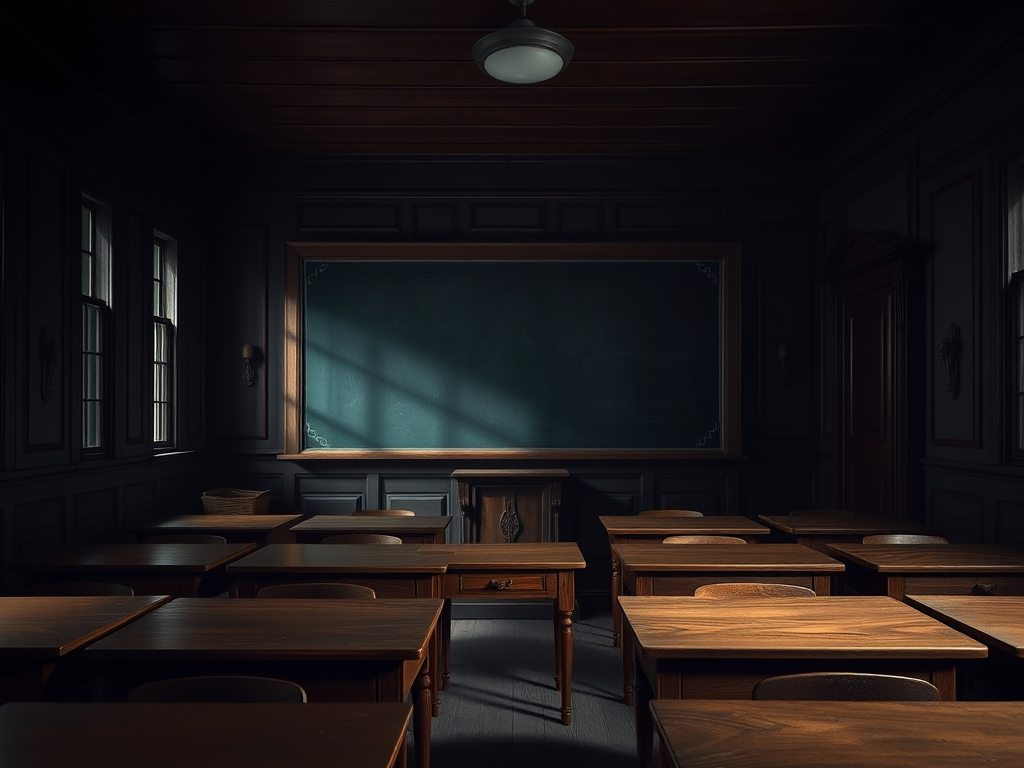
Abandoned, haunted schoolhouse
School as empire
Burning of Ichabod’s books
Educational connection to “Tarry” in Tarrytown
Ichabod Crane’s mental health
Marrying Katrina to get out of the teaching profession
Bachelorhood as a negative detachment from community
Moral of the story
After Ichabod’s disappearance, we learn since “he was a bachelor, and in nobody’s debt, nobody troubled his head any more about him, the school was removed to a different quarter of the hollow, and another pedagogue reigned in his stead” (1086*). And, right prior to the Postscript, Irving writes: “The schoolhouse being deserted, soon fell to decay, and was reported to be haunted by the ghost of the unfortunate pedagogue; and the plough boy, loitering homeward of a still summer evening, has often fancied his voice at a distance, chanting a melancholy psalm tune among the tranquil solitudes of Sleepy Hollow” (1087).
Much like the headless horseman who haunts Sleepy Hollow, Irving suggests Ichabod may haunt the area, too. Instead of roaring through town on a late-night ride, though, Ichabod Crane sings his way around the schoolhouse.
Singing? Do we have any other ghosts in American Literature who sing? He’s a Singing Connecticut Yankee Ghost. Any of those on the American stage? I’ll have to investigate the matter. A few of my colleagues may know a thing or two about that.
To be honest, I’ve never thought much about the haunting of the schoolhouse, the “educational building” of the town, to use jargon I picked up on my brief journey through architecture research last night. We typically think of the Old Dutch Church and the Church Bridge as central physical structures in the story, which could open up a conversation about faith, but the abandoned schoolhouse further pushes the idea of Ichabod Crane abandoning his spaces and belongings, and begs for an educational interpretation. Just as the “gazers and gossips…came to the conclusion, that Ichabod had been carried off by the galloping Hessian” (1086), the school, too, is “carried off” to a more agreeable location.
Midway through the story, Brom Bones plots practical jokes against Ichabod, making good use of the schoolhouse: “Ichabod became the object of whimsical persecution to Bones, and his gang of rough riders. They harried his hitherto peaceful domains; smoked out his singing school, by stopping up the chimney; broke into the school house at night, in spite of its formidable fastenings of withe and window stakes, and turned every thing topsy-turvy, so that the poor schoolmaster began to think all the witches in the country held their meetings there” (1071-72).
Not only does Ichabod Crane have to deal with Brom’s antics, but he also battles “evil doers” at the schoolhouse. Irving writes: “On a fine autumnal afternoon, Ichabod, in pensive mood, sat enthroned on the lofty stool from when he usually watched all the concerns of his little literary realm. In his hand he swayed a ferule, that sceptre of despotic power, the birch of justice reposed on three nails, behind the throne, a constant terror to evil doers; while on the desk before him might be seen sundry contraband articles and prohibited weapons, detected upon the persons of idle urchins, such as half munched apples, popguns, whirligigs, fly cages, and whole legions of rampant little paper game cocks” (1072).
The weaponry students use interests me. I’m not sure exactly what I might have to say about all the paraphernalia he gathers from them, but Ichabod accumulates sordid things, as evidenced by his personal collection of strange belongings left behind in a handkerchief when he vanishes.
And on that note, let me stop these ramblings and vanish from this week’s blog post. I’ll be back next week, God willing on Wednesday with clearer thoughts, to continue the conversation about pedagogy and Irving.
* Irving quotes are from the Library of America, published in 1983.
In the spring, a friend asked me, “Are you still doing your weekly blogs?” I said no, but had fantastic excuses why I haven’t kept up the ritual: I’ve posted guest and student blogs, we have plenty of content on the website, I’ve been busy with other work, I’ve been dealing with family issues, etc. Of course, the pathetic response I gave to my friend has been eating at me all summer.
At least for this school year, from now until May 2026, I’m committed to giving my Wednesdays back to Washington Irving. It may take me until 11:59 p.m. somewhere on the planet, and like my daily workouts, some blogs may be rushed and brief, but I will show up to publish something on the website.
If we have a student or guest blogger, I can set them up on Wednesday, but post on a day other than Washington Irving Wednesday, so please keep those coming, if you are so inclined.
The teaching of Irving’s texts, especially “Rip Van Winkle” and “The Legend of Sleepy Hollow” will probably be the subject of my next blogs for five main reasons:
I’m currently teaching an undergraduate class on Washington Irving.
People often email to ask for Irving teaching material, especially for “Rip Van Winkle” and “The Legend of Sleepy Hollow.”
It’s my understanding that Irving biographer Andrew Burstein has taught a course solely devoted to Washington Irving. I’d love to connect with others who have done the same. Perhaps we can unite our efforts in helping instructors who need teaching materials.
In October, I’m giving a paper on Washington Irving and Pedagogy for a conference.
I’m giving such a paper, and put together a pedagogy and literature panel, because my university, as of late, wants me to be an international superstar of pedagogy.
In part, I hope my blogging can help me work through ideas about the study of teaching Washington Irving–on a local, national, and international stage—to make a significant enough contribution to pacify my university’s “powers that be.”
Those who know me well recognize how much I hate having my picture taken and have no interest whatsoever in being recognized internationally as a star of anything. But I will play the game.
I gave up the rigorous study of pedagogy decades ago, after taking a handful of graduate classes in a College of Education. I appreciated, and still appreciate, the foundation I received in the theory of education, but chose a different path—to pursue literary studies, which brought me to Washington Irving.
My university has been kind to me, allowing me the freedom for many years to focus my attention on Washington Irving, but I’m being lassoed a bit with pedagogy restraints.
With these initial thoughts in mind, on this renewed Washington Irving Wednesday, I ask you to please like or dislike, comment in kind or unkind, to any upcoming content creation from me, since my academic career now demands such responses. I thank you in advance, and I have a hunch this shift in academia may benefit the Washington Irving Society more than I realize. I trust the work ahead of me will be a “win-win” situation for me, the university, and Irving scholarship.






 Washington Irving Society