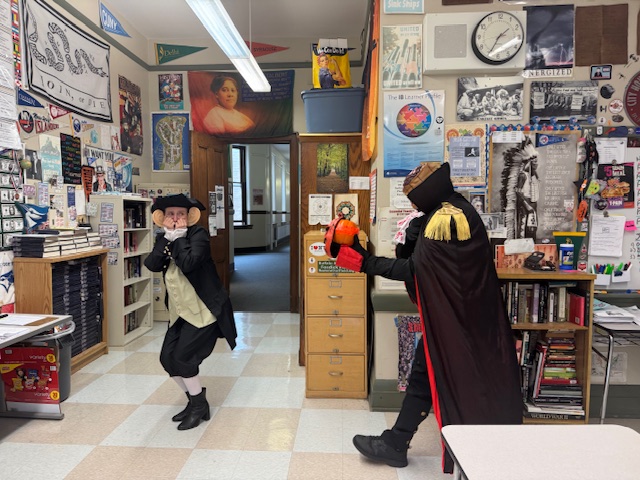
2025 Halloween photo of myself as Ichabod Crane with the AP U.S. History teacher as the Headless Horseman
November 5, 2025
BY CHERYL WEAVER
“Irving is really haunting the text!” —11th-grade student after class
I was initially uncertain about how to teach this text. Irving’s work had never appeared in any anthologies my district provided, and I hadn’t encountered Irving—at least in my memory (a Rip Van Winkle moment?)—until graduate school. I developed three main instructional objectives:
Thematic: The story serves as part of the narrative of a new nation, emphasizing identity as beyond the individual and situated within societal constructs.
Comprehension: Focus on Irving’s detailed descriptions of characters and settings, helping students understand why he invested so heavily in these descriptions.
Vocabulary: After reviewing the story, I identified a few words that might require additional support for my students.
Here’s an overview of the short plan I developed, incorporating various activities:
Day 1: Students were tired from taking the PSAT in the morning, so to introduce the story, I showed the 1949 Disney adaptation. We used a short worksheet to explore questions about the post-WW2 context and what this adaptation reveals about the United States at that time.
Days 2-4: I gave a brief PowerPoint presentation on Irving and began reading the story with the students. Using an “I do, we do, you do” approach, I read and annotated the text on the first day, having students note brief subtopics for each paragraph. This helped them practice organizing their writing. On the second day, we annotated together, and on the third day, students read and annotated a section individually. We concluded with a 20-question multiple-choice assessment to gauge their understanding and identify areas needing review.
On the last day, Halloween, I read the story’s conclusion dressed as Ichabod Crane. To strengthen cross-curricular connections, this unit aligned with the students’ AP U.S. History studies; their history teacher dressed as the Headless Horseman!
To further engage students and assess their understanding of the text’s connections, we started two class days with a game I designed. Topics included natural imagery, real and fictional characters, settings, and vocabulary, specifically focusing on last names and the term “cognomen” from “The Legend of Sleepy Hollow.”
Overall, students enjoyed the unit and made insightful connections between Irving’s role in crafting history and identity for the newly formed nation. One student remarked, “Irving is really haunting the text!”
Now, I’m beginning to introduce “Rip Van Winkle,” aiming for a culminating project where students can choose between a creative writing option, a traditional analysis essay, or a visual design incorporating elements of Irving’s story and themes.
I eagerly anticipate sharing my students’ creations with you!
Last week, I blogged about ChatGPT’s advice for 31 ways of teaching “The Legend of Sleepy Hollow” in the K-12 classroom, so this week, I’m adding the university setting to the conversation.
The categories changed somewhat, after I tweaked the prompt to focus solely on the university classroom. ChatGPT now suggests the following breakdown for teaching “The Legend of Sleepy Hollow”:
• Literary Analysis Approaches • Historical and Cultural Context • Interdisciplinary Methods • Comparative and Media Approaches • Classroom Activities and Projects
And here’s a reminder of the K-12 categories:
• Reading Comprehension and Analysis • Creative Activities • Literary and Historical Connections • Critical Thinking and Writing
Historical connections are listed for all learners, but cultural context was added for the university classroom. Cultural context for the story could include Dutch history, the Connecticut Yankee on stage, post-Revolutionary America, and more. Discussing Royal Tyler’s Jonathan in The Contrast (1787) probably wouldn’t work well in an elementary classroom, yet I can still imagine showing images of Connecticut Yankees to students of all ages.
Cultural context could still be relevant for younger students. But I get it. Reading Comprehension, a category set aside only for younger learners, would be more important than guiding students through the early American stage.
Lessons suggested for the university classroom, which I find particularly interesting, include:
LITERARY ANALYSIS APPROACHES
• Narrative Voice and Unreliable Narration: Discuss the frame narrative and how Diedrich Knickerbocker’s voice affects interpretation.
• Symbolism and Allegory: Explore the Headless Horseman as a symbol of the past, American identity, or suppressed fears.
• Genre Study/Gothic and American Romanticism: Place the tale in the context of early American Gothic literature and Romanticism.
• Satire and Humor: Examine Irving’s use of irony, exaggeration, and social satire—especially about education and religion.
HISTORICAL AND CULTURAL CONTEXT
• Puritanism and Superstition: Explore lingering religious influences and community beliefs in the supernatural.
• The American Frontier and Wilderness: Use landscape to discuss nature as a source of fear, imagination, and identity.
INTERDISCIPLINARY METHODS
• Ecocriticism: Analyze the role of nature, landscape, and environment in shaping emotion and meaning.
COMPARATIVE AND MEDIA APPROACHES
• Cross-Cultural Ghost Stories: Compare with ghost tales from other cultures or time periods (e.g., Japanese yūrei stories).
• Myth-Making in American Culture: Discuss the legend as part of America’s myth-making and creation of national folklore.
CLASSROOM ACTIVITIES AND PROJECTS
• Creative Writing/Alternate Ending: Ask students to write a different conclusion or a modern retelling of the tale.
• Map the Geography of Sleepy Hollow: Use historical maps and imagination to create visual layouts of the story’s setting.
• Multimedia Project/Audio Drama: Students produce a podcast version with sound effects, voice acting, and narration.
• Field Trip or Virtual Tour: Visit Sleepy Hollow, NY (virtually or in person), exploring Irving’s historical context and the landscape.
A field trip to Sleepy Hollow sounds like the very best idea, especially if I could take my entire class from Texas. Any wealthy donors want to make an end-of-year contribution to a most deserving 501-C3? One day, perhaps, I can take a crew to New York for the fall, the best time to go. In the meanwhile, a virtual tour of Sleepy Hollow sounds like a worthwhile endeavor.
The Multimedia Project/Audio Drama reminds me of what I already do with my classes. Students work in groups to put together podcasts, but I don’t make them perform the text. They simply chat about Irving or whatever we’re studying. However, I could see myself adjusting this assignment for future semesters. Professors are often concerned about whether students have done the reading. If they perform the text, then there’s no doubting whether they’ve read it.
For the Creative Writing/Alternative Ending suggestion, I already gave a nod to rewriting the end of “Sleepy Hollow” for K-12, but it’s repeated here for college students. I shall definitely give this a whirl in the spring. We’ve already read “The Legend of Sleepy Hollow” in all of my classes for this semester.
Cross-Cultural Ghost Stories could be worthwhile, and the suggestion of including Japanese stories fascinates me. I’m always looking for ways to merge Washington Irving with Asian-American Literature, which I’ve started teaching recently, and ghost stories would be another way of doing so.
The American Frontier, Ecocriticism, and Mapping Sleepy Hollow stand out to me since, earlier this afternoon, my Washington Irving class read and discussed “The Adventure of the German Student,” which appears in Tales of a Traveller (1824). From the very beginning of the story, Irving paints the Paris scene, as he sets up Tarry Town in “The Legend of Sleepy Hollow.” Instead of “the bosom of one of those spacious coves which indent the eastern shore of the Hudson,” we get “a stormy night, in the tempestuous times of the French Revolution” along with “loud claps of thunder,” reminiscent of “Rip Van Winkle.”
By the way, this is what I’ve been listening to while writing this blog, in case you were wondering:
I took the advice of my blog from last week, to consider music/playlists as I’m teaching Irving’s texts. For some reason, guitar music always reminds me of Washington Irving, perhaps because of his stay at the Alhambra and my listening to many a Spanish guitar while visiting Granada and southern Spain.
With dogs barking outside my office window, the cleaning staff vacuuming outside my door, and with my office still sitting at 80 degrees, I needed noise-canceling headphones, strong Starbucks coffee, and instrumental guitar music to help me say something in a blog before 11:59 p.m. on this Washington Irving Wednesday. Hopefully, a thing or two I’ve shared will be useful to you.
My students have compiled playlists of their own, in response to one of my midterm exam questions, and I’ll share their suggestions for next week’s blog. The music selections, which remind them of Washington Irving, made me smile, and I think you’ll enjoy their suggestions, too. Until next week.
When I teach Salmagundi, I always think about bringing a salmagundi salad to class, but then I decide anchovies probably aren’t the best idea. I wouldn’t want anyone to connect our Washington Irving class to a fishy smell.
According to the Oxford English Dictionary, salmagundi consists of “chopped meat, anchovies, eggs, onions with oil and condiments.”* But when I’ve made my version of salmagundi, I tend to avoid any extra “chopped meat.” The anchovies are enough, but you can make it however you like. The idea is a mixed salad, and we all know how to throw together a salad we like.
My class has cruised through the most popular stories: “Rip Van Winkle,” “The Legend of Sleepy Hollow,” “The Devil and Tom Walker,” and the Bracebridge Christmas stories. I wanted to give students a fun, easy way to start the class, and to get everyone on the same page since a handful had already read Irving in previous classes.
With the basics down, this week we began the chronological sampling of Irving’s larger body of work, starting with the Mustapha letters from Salmagundi. The plan is to finish the semester with snippets from the five George Washington volumes. I only assigned students three of the Mustapha letters, but many also ventured into other articles, so I trust everybody got an overall feel for the twenty issues of Salmagundi.
With all that’s going on this Wednesday of 2025, I find myself trying to imagine Washington Irving’s world of 1807, more than a decade before he published “The Legend of Sleepy Hollow.” Instead of continuing to deal with Ichabod Crane’s role as the chief pedagogue, my mind has drifted into the troubling times of Irving’s life while doing earlier periodical work.
According to the Library of America’s chronology, Irving spends 1807-1808 doing the following:
“Co-authors Salmagundi, which receives much praise, with William Irving and James Kirke Paulding.
Is a sympathetic spectator at the trial of Aaron Burr in Richmond.
Makes periodic visits to Philadelphia.
Father dies October 1807; sister Ann Dodge dies May 1808.
Continues to visit the Hoffman household and falls in love with Matilda Hoffman.
With Peter Irving, conceives the idea of a burlesque historical guidebook to New York. Begins work on it June 1808” (1095).**
It’s almost unimaginable to think of losing father and sister in less than a year, all the while falling in love with Matilda Hoffman, who herself passes away, a little later, in the spring of 1809. The country deals with Aaron’s Burr’s charge of treason, and through all of life’s difficulties, Irving co-writes, anonymously, articles for Salmagundi with his brother William and James Kirke Paulding. He also begins work on more satire, as he plans A History of New York.
Today, in class, I wanted to talk about the pedagogy of genre with regard to satire, and to do some writing activities involving different kinds of satire, but I decided to hold that thought until next week when we read portions of A History of New York. Right now, asking students to critique our society in a satirical way feels forced, but I thought mocking the early days of the Republic of Texas next week, alongside Irving’s mocking of New York, would open up a useful application of the genre. I’ll report back next week to let you know how Texas measures up to New York. Until then.
The obvious choice for launching a conversation about pedagogy and Washington Irving would be “the worthy pedagogue,” Ichabod Crane. In fact, our Sleepy Hollow superstar of pedagogy could probably keep me busy blogging for the rest of 2025.
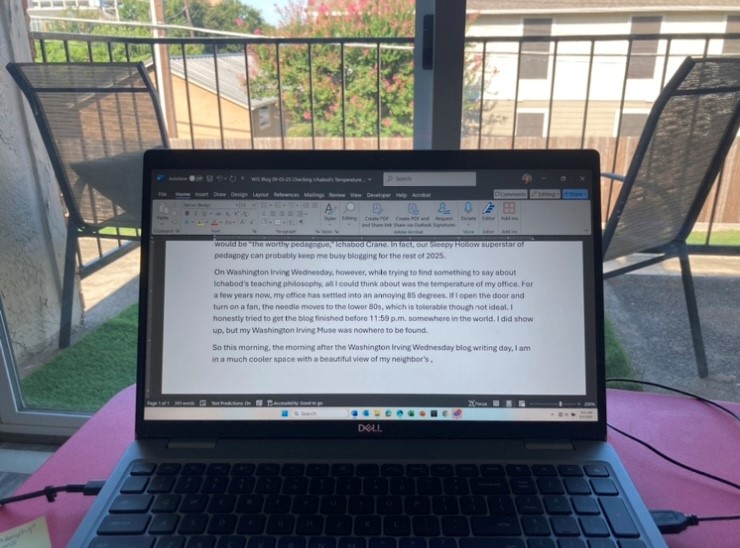
On Washington Irving Wednesday, however, while trying to find something to say about Ichabod’s teaching, all I could think about was the temperature of my office. For a few years now, my office on campus has settled into an annoying 85 degrees. If I open the door, turn on a fan, and keep the lights off, the needle moves to the lower 80s, which is tolerable though not ideal. I honestly tried to get this blog finished before 11:59 p.m. somewhere in the world. I did show up and began writing, but my Washington Irving Muse was too hot and bothered to offer much assistance.
This Thursday morning, the morning after Washington Irving Wednesday, I am in a much cooler space with a pretty view of blue skies and hot pink crepe myrtle bushes. I apologize for posting Thursday, instead of Wednesday, but I didn’t feel comfortable sharing all the pedagogical thoughts going through my head last night about the “thermal comfort” of “educational buildings” negatively impacting mental health. (Can you tell I was digressing into scholarly articles about architecture, psychology, and more?) My thoughts and the temperature were out of control, so I shut everything down at 8:30 p.m. Texas time. I’m in a much better space, mentally and physically, this morning.
A few nights ago, I re-read “The Legend of Sleepy Hollow” since my undergraduate students this week have been reading it, along with “Rip Van Winkle,” and “Philip of Pokanoket.” My intent was to notice everything related to teaching, which allowed me to consider some passages I haven’t thought about in a while, or ever. I’ll do my best to unpack a few ideas today, think about Ichabod Crane over the weekend (which sounds like a very odd thing to do), and pick up my thoughts again next week.
What struck me most a few days ago, and what jumps out to me now, after my evening with “climate control” pedagogy, include:
Abandoned, haunted schoolhouse
School as empire
Burning of Ichabod’s books
Educational connection to “Tarry” in Tarrytown
Ichabod Crane’s mental health
Marrying Katrina to get out of the teaching profession
Bachelorhood as a negative detachment from community
Moral of the story
After Ichabod’s disappearance, we learn since “he was a bachelor, and in nobody’s debt, nobody troubled his head any more about him, the school was removed to a different quarter of the hollow, and another pedagogue reigned in his stead” (1086*). And, right prior to the Postscript, Irving writes: “The schoolhouse being deserted, soon fell to decay, and was reported to be haunted by the ghost of the unfortunate pedagogue; and the plough boy, loitering homeward of a still summer evening, has often fancied his voice at a distance, chanting a melancholy psalm tune among the tranquil solitudes of Sleepy Hollow” (1087).
Much like the headless horseman who haunts Sleepy Hollow, Irving suggests Ichabod may haunt the area, too. Instead of roaring through town on a late-night ride, though, Ichabod Crane sings his way around the schoolhouse.
Singing? Do we have any other ghosts in American Literature who sing? He’s a Singing Connecticut Yankee Ghost. Any of those on the American stage? I’ll have to investigate the matter. A few of my colleagues may know a thing or two about that.
To be honest, I’ve never thought much about the haunting of the schoolhouse, the “educational building” of the town, to use jargon I picked up on my brief journey through architecture research last night. We typically think of the Old Dutch Church and the Church Bridge as central physical structures in the story, which could open up a conversation about faith, but the abandoned schoolhouse further pushes the idea of Ichabod Crane abandoning his spaces and belongings, and begs for an educational interpretation. Just as the “gazers and gossips…came to the conclusion, that Ichabod had been carried off by the galloping Hessian” (1086), the school, too, is “carried off” to a more agreeable location.
Midway through the story, Brom Bones plots practical jokes against Ichabod, making good use of the schoolhouse: “Ichabod became the object of whimsical persecution to Bones, and his gang of rough riders. They harried his hitherto peaceful domains; smoked out his singing school, by stopping up the chimney; broke into the school house at night, in spite of its formidable fastenings of withe and window stakes, and turned every thing topsy-turvy, so that the poor schoolmaster began to think all the witches in the country held their meetings there” (1071-72).
Not only does Ichabod Crane have to deal with Brom’s antics, but he also battles “evil doers” at the schoolhouse. Irving writes: “On a fine autumnal afternoon, Ichabod, in pensive mood, sat enthroned on the lofty stool from when he usually watched all the concerns of his little literary realm. In his hand he swayed a ferule, that sceptre of despotic power, the birch of justice reposed on three nails, behind the throne, a constant terror to evil doers; while on the desk before him might be seen sundry contraband articles and prohibited weapons, detected upon the persons of idle urchins, such as half munched apples, popguns, whirligigs, fly cages, and whole legions of rampant little paper game cocks” (1072).
The weaponry students use interests me. I’m not sure exactly what I might have to say about all the paraphernalia he gathers from them, but Ichabod accumulates sordid things, as evidenced by his personal collection of strange belongings left behind in a handkerchief when he vanishes.
And on that note, let me stop these ramblings and vanish from this week’s blog post. I’ll be back next week, God willing on Wednesday with clearer thoughts, to continue the conversation about pedagogy and Irving.
* Irving quotes are from the Library of America, published in 1983.




 Washington Irving Society