Wassailing through Another Semester

AI-Generated using WordPress

Wednesday, December 10, 2025

BY TRACY HOFFMAN

Today, my Washington Irving class finished up our semester together. They still have final exams, and I still have grades to crunch, but today was the last day of classes. To finish off our time together, students worked on blogs, which will soon appear on the Washington Irving Society page, and I also put together a mini Wassail Fest in our classroom.

The wassail bowl is passed around in Washington Irving’s Christmas stories, so it seems appropriate for us to enjoy a similar beverage. Irving writes: “When the cloth was removed, the butler brought in a huge silver vessel of rare and curious workmanship, which he placed before the Squire. Its appearance was hailed with acclamation; being the Wassail Bowl, so renowned in Christmas festivity. The contents had been prepared by the Squire himself; for it was a beverage in the skilful mixture of which he particularly prided himself; alleging that it was too abstruse and complex for the comprehension of an ordinary servant. It was a potation, indeed, that might well make the heart of a toper leap within him; being composed of the richest and raciest wines, highly spiced and sweetened, with roasted apples bobbing about the surface.”

Of course, we didn’t have apples bobbing, nor did we have racy wine.

Irving continues: “The old gentleman’s whole countenance beamed with a serene look of indwelling delight, as he stirred this mighty bowl. Having raised it to his lips, with a hearty wish of a merry Christmas to all present, he sent it brimming round the board, for every one to follow his example, according to the primitive style: pronouncing it ‘the ancient fountain of good feeling, where all hearts met together.'”

We didn’t pass wassail round the room, but I did circulate the room, pouring the samples. Irving calls the wassail “the honest emblem of Christmas joviality.” I’m not quite sure my students felt much “Christmas joviality” as they face finals, but perhaps when they reach the other side of their exams, they will have happy thoughts about our wassailing efforts.

For our Wassail Fest, three students volunteered to make their own versions of wassail, using various combinations of:

  • Apples
  • Oranges
  • Cinnamon
  • Nutmeg
  • Cloves
  • Ginger
  • Sugar
  • Apple Juice

I brought the fruit, juice, spices, containers, knife, peeler, and measuring spoons. Each contestant assembled a wassail blend, and then I mixed the blend with two cups of 100% apple juice. When the tea kettle cut off, the batch was complete.

We had a taste test and voted, but in the end, all three wassails were excellent. I will be emailing all of our contestants certificates for winning the First Annual Washington Irving Wassail Fest at Baylor University.

The first concoction didn’t have too much spice, so it wasn’t far from apple juice, but still quite good. The second one was a little more spicy, and also quite good. And the final beverage included extra sugar, so we all agreed the sugar made the spices pop. I felt like it would be a good beverage if you had a cold. It seemed like it could awaken all the senses, though the sugar content probably wouldn’t be so great if you were sick.

One student was allergic to cinnamon, so she couldn’t participate. I’ve had students allergic to peanuts, so I’m accustomed to leaving nuts out of most anything I bring to class, but someone being allergic to spices never crossed my mind. Fortunately, the smell of cinnamon is okay. She just couldn’t ingest it. Everybody agreed the classroom smelled like Christmas after we started brewing our beverages.

In fact, one student who had recently recovered from a nasal infection was excited to realize she could now smell! Her olfactory system hadn’t been working properly, but the power of wassail returned her sense of smell.

Smelling cinnamon makes me happy, too. I remember sniffing cinnamon every morning the one time I had Covid in 2022. I monitored the situation with cinnamon, ginger, and coffee smell checks. I was happy that very first time I could smell cinnamon once again, and that happiness hits me again when I get a whiff of it.

At some point over the holiday break, I’ll put all the ingredients in a big pot on the stove to make my home smell like Christmas, too. And, of course, the wassail tastes much better after simmering on the stove for awhile, instead of quickly boiling in a tea kettle, like we did in the classroom.

I’m aware of at least three major Wassail Fests in Texas: San Marcos, Denton, and Paris. A few of these have already happened, but the Paris event is scheduled for this weekend. I may give it a go:

https://business.paristexas.com/events/details/14th-annual-wassail-fest-19657

And here’s the audio recording of today’s blog:

Pedagogy of Chautauqua: “Round the Campfire” Conversations about Irving’s Tour on the Prairies

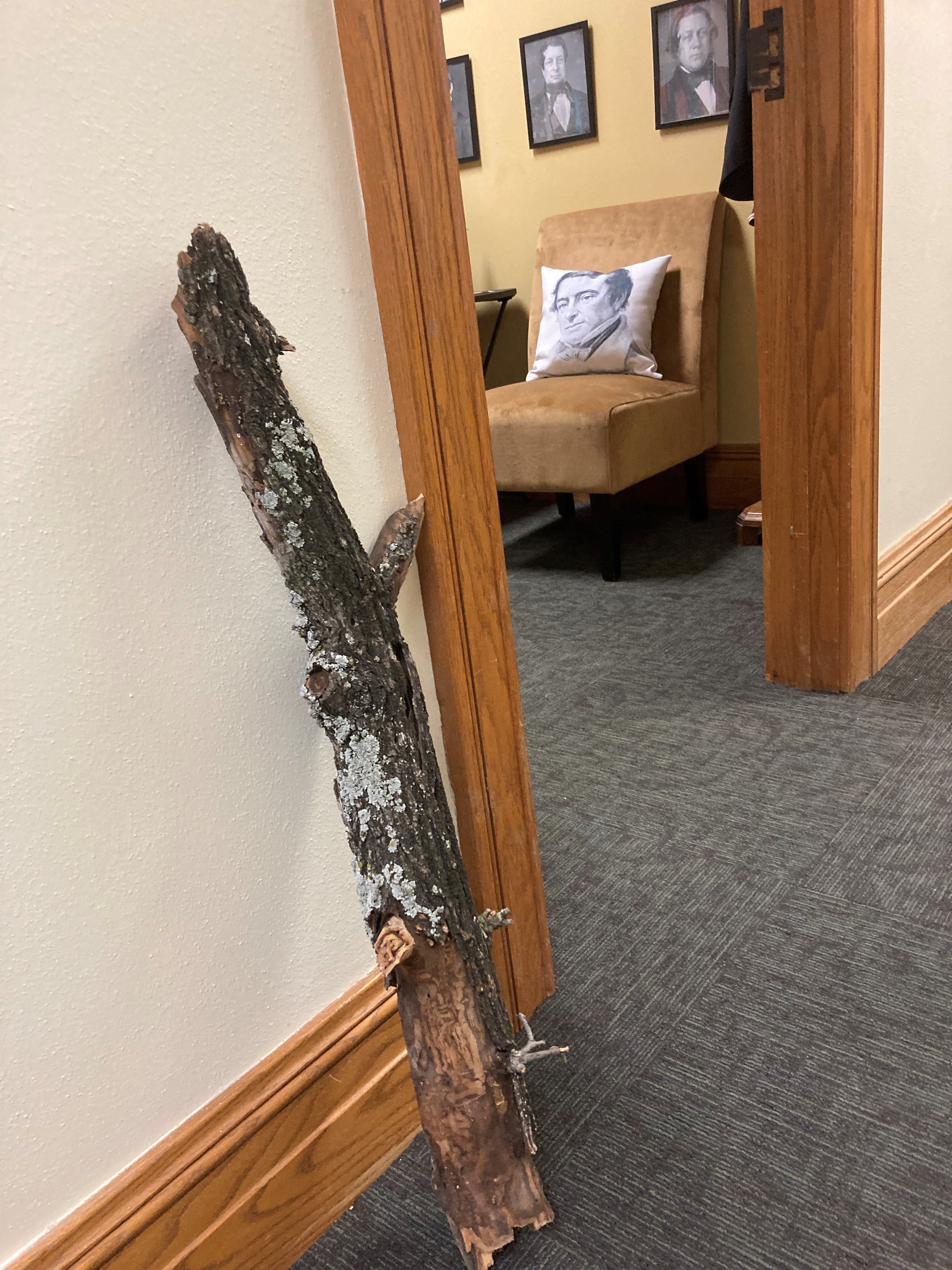
This log has camped out near my office for the past week. (And yes, that’s Washington Irving decor in my office.) Photo by Tracy Hoffman

Wednesday, November 12, 2025

BY TRACY HOFFMAN

My Washington Irving class completed our reading of A Tour on the Prairies today. If some of you were working through the text along with us, congratulations! We made it to Chapter 35.

I would like to thank Cheryl Weaver for crafting two wonderful blogs during the Halloween season while teaching “The Legend of Sleepy Hollow.” She gave me a few weeks to catch up, and it was better to hear about “Sleepy Hollow” during October than Irving’s buffalo hunt. Thank you, Cheryl. You’re awesome!

In the next few weeks, I’ll try to touch on themes my class discussed on our adventure through Oklahoma Territory with Washington Irving, but for today, I want to focus on one overall idea we used in the classroom–chautauqua.

The class concluded our study with a Zoom chat featuring Dr. John Dennis Anderson, who performs as Washington Irving. Another special thanks goes out to John for spending time with us today. Thank you! Thank you! John told the class how fortunate they were to have Dr. Hoffman as their instructor, and I reminded them of how lucky they were to have John Anderson join them for a conversation.

Awhile back, after having my class watch John’s performance on YouTube, I decided to experiment with chautauqua in the classroom. As I told John later, he makes it look easy, but it’s not that easy. Despite the challenges, the experience was still a fun classroom experiment. I would highly recommend teachers of literature apply such a technique to their teaching repertoire.

At the beginning of our journey through Irving’s book, I assigned each student one of the following characters or people groups. Their goal was to focus on these folks during the readings and be prepared to report on the assigned characters for upcoming reading quizzes:

  1. Washington Irving, the narrator
  2. Swiss Count (Albert-Alexandre de Pourtalés)
  3. Mr. L (Charles Latrobe)
  4. Commissioner/Rangers
  5. Tribes
  6. Settlers
  7. Antoine (not Tonish)
  8. Tonish (Antoine)
  9. Pierre Beatte

I’ve done this sort of thing before, most often when I teach Amy Tan’s Joy Luck Club. Following one of the four mothers or one of the four daughters works great for keeping up with the very detailed reading. Anyhow, beyond a close reading of characters, I added a chautauqua component.

Instead of giving students a quiz at the beginning of class to check their reading, I gave the quiz at the end of class, after we had chatted about the reading, from each character’s vantage point. It was uncomfortable at first, but I forced everybody to do their best to get into character, to have a conversation as if your characters were sharing “round the campfire,” like Irving and his companions spend their evenings on the prairies talking about the day’s events.

For a performance, John Anderson typically appears in character for the greater portion of his time and then steps out of character for the final part. However, my students and I were not able to stay in character for long. We found ourselves wanting to step aside and add commentary and ask questions, so we simply modified the process to flow in and out of character as needed.

For three classes, we followed a chautauqua-style conversation, which forced students to move their chairs, get out of the regular rows, and face me and each other. This shook a few of my “back row Baptist” students into a more significant role in the conversation. I really enjoyed hearing these students open up, and I hope they enjoyed playing a greater role in our chats.

For three classes in a row, I added to our makeshift “campfire.” At first, it was only an old Baylor popcorn can with construction-paper cut into flame-shaped shards of red, yellow, and brown.  I’ve heard tissue paper works better, but I didn’t have any of that on hand.

On Wednesday of last week, I exited my car, after arriving on campus, and immediately spotted a nice log—a branch which had obviously fallen during recent storms. I carefully lugged it to my office, where it sat in the hallway until class time. One of my colleagues passed by my office that day and said, “I like your log,” and kept walking.

One of my friends over the weekend said we needed smores, but I said no, since Irving had zero smores on the prairies. He did, however, have brown sugar with his black coffee. I scrounged up a canister of Folgers from the faculty lounge, but my personal coffee maker needed cleaning before sharing it with students. Next time I teach the book, I’ll be sure to reenact all the coffee drinking, which I appreciate.

My students told me we needed rocks to properly set up a campfire, so I “borrowed” a bag full of rocks from a lovely flower bed. (Hopefully, my HOA didn’t notice my digging in the flower beds on the security camera.) My students weren’t fans of the rocks I gathered, since they weren’t big enough to enclose a real campfire. Again, I have goals for the next time I teach the book.

It’s getting late, and I still need to return the rocks to their proper home, so I’ll stop for now. I’ll catch you next week for more debriefing about Irving’s Tour on the Prairies. Until then, you can check out one of John’s performances: https://www.youtube.com/watch?v=XXCoEwa2dqk

Ichabod Crane in the Twenty-First Century High School Classroom

Photo by Cheryl Weaver

October 29, 2025

BY CHERYL WEAVER

“That all this might not be too onerous on…his rustic patrons, who are apt to consider…schoolmasters as mere drones.”

The first time I encountered Irving’s work—aside from vague childhood memories of Disney’s 1949 The Adventures of Ichabod and Mr. Toad and my young adult adoration of Tim Burton’s 1999 Sleepy Hollow—I sat enthralled as my graduate school American Lit professor regaled me with Irving’s importance. Who knew, I thought, as I considered the context of Irving’s Rip Van Winkle, that Irving’s project played such a role in creating an American cultural identity? Roughly ten years later, my interest in Irving reignited when I was awarded a fellowship through the Women’s History Institute at Historic Hudson Valley. My research centered on women’s letters and the United States Post Office, but archivist Catalina Hannan’s knowledge and enthusiasm for Irving piqued my interest once again.

At the May ALA conference, I attended a panel hosted by the Washington Irving Society and met the Society’s President, Tracy Hoffman. We spoke briefly at the WIS Business Meeting: she, thinking ahead about the direction of the Society, and I, puzzling out how I could contribute, turned to pedagogy—not an altogether drastic turn considering Ichabod Crane’s occupation. We made tentative plans to develop instructional materials and methods for engaging learners of all academic levels in the serious study of the author. Ideas began percolating in my mind about how I could fit Irving thematically into my current curriculum.

I teach Language and Literature at a public high school boasting a robust International Baccalaureate program. My students are academically successful, with the expected mischievous nature of young people. (There are a few young Brom Boneses in my midst—harmless, though boisterous.) I needed to hatch a plan to cover the author and share my own adoration of his work. But I had some fundamental questions to consider first.

What exactly do my high school students know about Irving? Sure, most are familiar with the broad strokes—a headless man atop a strong steed, knife in hand, roaring and galloping toward his frightened object desperate to escape across a bridge. But would they be interested in the original text? Further, how could I frame Irving within the parameters of my course and work on stronger cross-curricular planning?

And then it hit me.

Could I position Washington Irving as America’s first influencer? Could that be a starting point to engage my students in reading Irving’s text? Could my larger curricular focus on identity use Washington to consider individual, regional, and national identities and how those are formed?

Those questions frame the unit I’ve just begun on Irving’s stories, timed to coincide with the same historical period in my students’ course on U.S. History…and Halloween. A few days in, students seem to be receptive (more on that to come!), and I anxiously await their reaction when I appear in class on Friday as Crane before they head to their history class, taught by a certain headless horseman.

Ichabod Crane Still Haunts My Brain: Pedagogical Thoughts about Sleepy Hollow’s Connecticut Yankee

AI Generated in WordPress

Wednesday, September 10, 2025

BY TRACY HOFFMAN

Over the weekend and into this week, I’ve continued thinking about Ichabod Crane as a teacher and ghost.

These ruminations have blended with concerns about A Christmas Carol by Charles Dickens since the beautiful building, which comprises my 85-degree office, will soon be turned into a haunted-house-of-sorts for Scrooge’s ghosts. I will most certainly get around to writing about the impending mayhem in future blogs. Suffice it to say for today, my Ichabod thoughts have been tainted by a foreboding sense of Charles Dickens.

My mental image of Ichabod Crane coexists with pictures of the Dickens’ character Uriah Heep from David Copperfield. Physically, they look the same in my mind’s eye, even though I realize Ichabod is a much livelier character than Uriah. But let me stop myself from going further into the Dickens rabbit hole. (If you want to jump into Elizabeth Bradley’s article, “Dickens and Irving: A Tale of Two Christmas Tales,” you’ll be ready for my future conversations as we get closer to December.)

The big research questions I pose today are:

  1. Is Ichabod Crane the first Connecticut Yankee Pedagogue Ghost in American Literature?
  2. Is Ichabod Crane the first Connecticut Yankee Ghost in American Literature?
  3. Is Ichabod Crane the first Connecticut Yankee Teacher in American Literature?

I think we know the answers to all these questions. American Literature isn’t necessary. Where else would we see a Connecticut Yankee? Yes, of course, he would be the first in all three categories. The first two questions/descriptions are so bizarre and specific, I can’t imagine another character fulfilling them. But my last question has me thinking.

Yes, I believe Ichabod Crane is our first Connecticut Yankee who teaches. But why, in the development of the Connecticut Yankee, did Irving choose to make him a teacher?  

Ichabod Crane balances between the Jonathan character of Royal Tyler’s The Contrast (1787) and Hank Morgan of Mark Twain’s Connecticut Yankee in King Arthur’s Court (1889). David Gamut of James Fenimore Cooper’s Last of the Mohicans (1826), appearing a short time after Irving’s character, keeps the role as a music teacher, but Hank Morgan has lost the teaching quality by 1889.

According to Gary Denis, in Sleepy Hollow: Birth of the Legend (2015), Irving transfers some of the stereotypical qualities of the Yankee onto Brom Bones and refines Ichabod’s role to make him an “educated city-slicker” instead of “the country dweller” (158). Denis points to Irving’s improvement: “Irving is thereby credited as having been the first to introduce a conflict between East and West, the refined and cultured Connecticut Yankee vs. the rough-hewn frontiersman” (158).

But I’m still left with—Why? Why did Irving choose a teacher for Ichabod’s profession? We know that the minister and Ichabod Crane are the two most educated fellows in Sleepy Hollow, so I understand the options were limited.

We can study Jesse Merwin, Irving’s teacher friend who inspired the character. And we can consider Ichabod B. Crane, the military officer and inspiration for Ichabod’s name. With more research to investigate, I’ll close the blog out for now. My quest to understand Ichabod Crane, the pedagogue, continues.

Today, my students are reading “The Devil and Tom Walker,” and I can see Dickens borrowing heavily from Irving’s story to benefit his own Christmas Carol, so my blog next Wednesday could easily collapse into my own Dickens’ nightmares.